
For a Procurement Manager, the difference between a high-performing production line and a costly shutdown often comes down to the consistency of raw materials. In the global starch market, tapioca is prized for its neutral flavor, high paste clarity, and freeze-thaw stability. However, not all suppliers maintain the same rigorous standards.
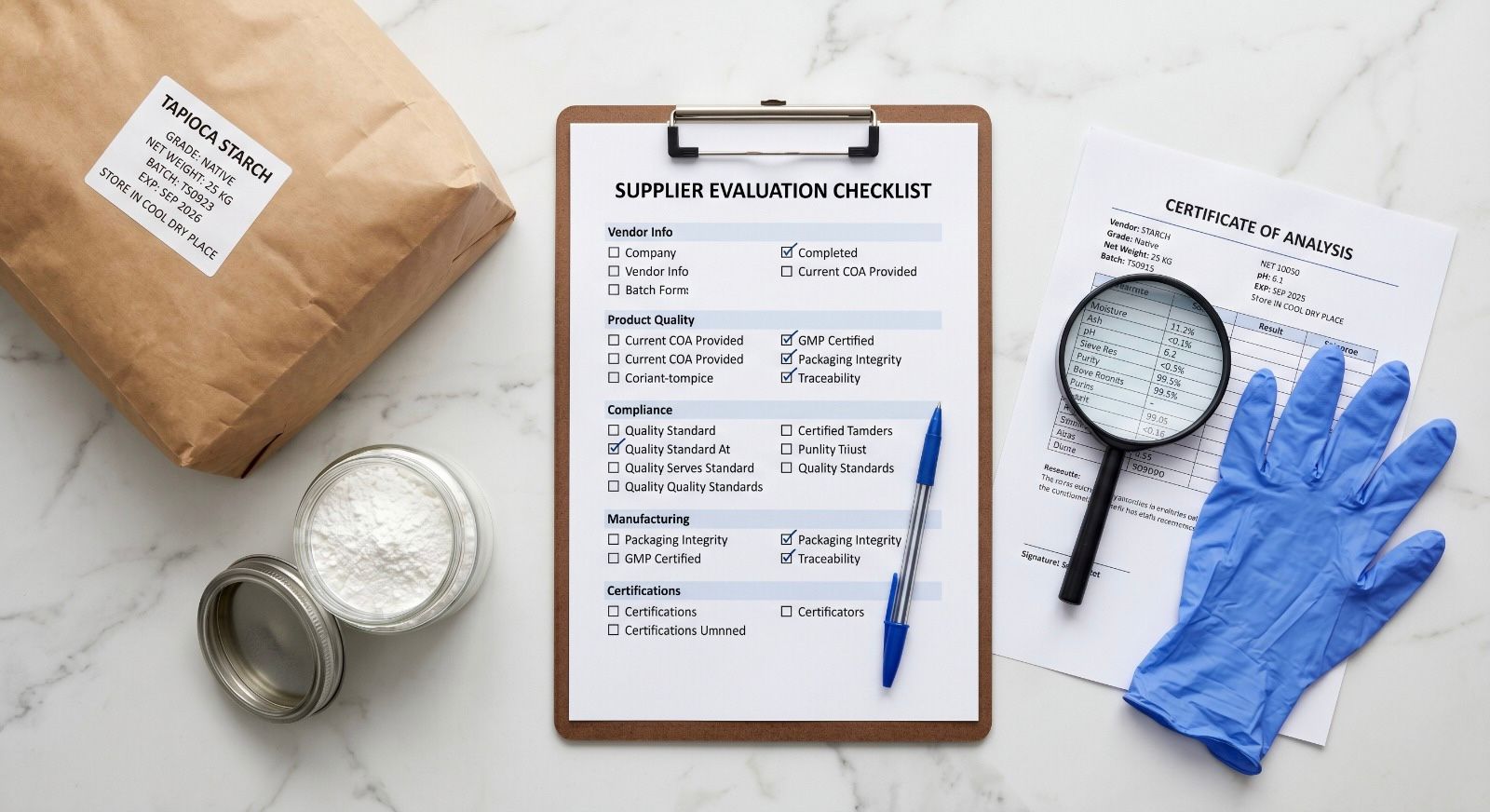
To evaluate a tapioca starch supplier, verify six key areas: starch content (minimum 85%), moisture levels (under 13%), viscosity stability, microbiology compliance, ethical sourcing certifications (HACCP/GMP), and supply chain reliability. A premium supplier like Blue Highcrest provides comprehensive technical data sheets and samples to ensure consistent performance in high-volume bulk procurement.
When sourcing tapioca starch at scale, “cheap” often becomes expensive. Variations in viscosity or moisture can ruin the texture of sauces, snacks, and gluten-free baked goods. Beyond the physical product, you are vetting the supplier’s ability to mitigate risks in the global supply chain.
By following these six quality checkpoints, you can move from simple price comparison to a high-authority qualification process that secures your production ROI.
The purity of the starch directly impacts its binding and thickening capabilities. High-quality native tapioca starch should contain a minimum starch content of 85%.
Purity: Ensure the supplier provides a “Low Ash” content (typically below 0.2%).
pH Levels: Look for a neutral pH between 5.0 and 7.0.
Whiteness: In the food and paper industries, a whiteness index above 90% is the gold standard for maintaining the visual integrity of the end product.
Moisture is the enemy of shelf life and flowability. Excess moisture leads to clumping in silos and increases the risk of microbial growth during transit.
Bulk buyers should insist on a moisture content of 12.5% to 13.5%. Any higher, and you are essentially paying for water weight and inviting mold issues. Blue Highcrest utilizes advanced drying technologies to ensure that every metric ton delivered meets strict atmospheric stability requirements, regardless of the shipping destination.
For industrial applications, the “thickening power” is measured by viscosity. This is usually determined using a Brabender Viscograph or a Rapid Visco Analyzer (RVA).
Peak Viscosity: The supplier must provide data on how the starch behaves under heat and shear.
Consistency: A “one-off” good sample is meaningless. Ask for historical data to prove that their Batch A performs exactly like Batch Z.
Transparency: If a supplier cannot provide a detailed Certificate of Analysis (COA) for each batch, they are not a viable partner for professional procurement.
In today’s regulatory environment, food safety is non-negotiable. Your supplier must be a fortress against contamination. A reputable tapioca starch supplier should adhere to the following microbiological limits:
Total Plate Count (TPC): < 10,000 cfu/g
Yeast & Mold: < 100 cfu/g
Pathogens: Absent in 25g (Salmonella, E. coli).
At Blue Highcrest, we treat food safety as the foundation of our partnership, ensuring our starch meets the stringent requirements of international food safety governing bodies.
A supplier’s paperwork says as much about them as their product does. When conducting vendor research, look for these “Must-Have” certifications:
HACCP & GMP: The baseline for food-grade manufacturing.
ISO 9001/22000: Evidence of a robust quality management system.
Halal & Kosher: Essential for reaching global consumer markets.
Non-GMO Project Verified: Tapioca is naturally non-GMO, but official certification simplifies your own labeling requirements.
Traceability is equally vital. Can the supplier track the starch back to the specific farm or collection point? If the answer is no, your supply chain is exposed to ethical and quality risks.
A great product is useless if it is stuck at a port. Evaluate the supplier’s logistical infrastructure.
Lead Times: Do they have a proven track record of meeting deadlines during peak seasons?
Incoterms Expertise: Do they understand the nuances of FOB, CIF, or DDP shipping?
Scalability: If your demand doubles next quarter, can they scale without compromising quality?
Evaluating a tapioca starch supplier requires looking beyond the price per kilogram. By focusing on starch purity, moisture control, viscosity, safety, certification, and logistics, you protect your company from production failures and brand damage.
Blue Highcrest specializes in bridging the gap between premium Southeast Asian tapioca production and the rigorous demands of global procurement managers. We don’t just ship starch; we provide the technical assurance and supply chain stability your business needs to thrive.
Stop gambling with inconsistent suppliers. Contact the experts at Blue Highcrest today to request a technical consultation or a sample kit. Let us show you how our 6-point quality protocol can streamline your production.
The industry standard for high-quality native tapioca starch is between 12.5% and 13.5%. This range ensures optimal shelf life and prevents clumping during industrial processing.
You should request a Certificate of Analysis (COA) that includes Brabender or RVA (Rapid Visco Analyzer) results. Comparing these results across different batches will tell you if the supplier’s production is consistent.
Yes, tapioca is naturally gluten-free and non-GMO. However, for procurement purposes, you should ensure your supplier has “Non-GMO Project Verified” and “Gluten-Free” certifications to prevent cross-contamination risks in the facility.
Most international bulk orders are handled via FOB (Free On Board) or CIF (Cost, Insurance, and Freight). Experienced suppliers like Blue Highcrest can also assist with more complex logistical arrangements to suit your specific warehouse requirements.