
For procurement managers overseeing global food, paper, or textile manufacturing lines, diversifying raw material origins is a core strategy to mitigate risk. In the global starch market, while traditional origins frequently face extreme weather disruptions and volatile shipping congestion, Indonesia has emerged as an incredibly stable powerhouse for premium native and modified tapioca starch.
However, entering a new geographic supply chain requires more than comparing price sheets. To establish a resilient pipeline, procurement professionals must understand the logistical infrastructure of Indonesian sourcing, identify non-negotiable international certifications, and successfully navigate standard minimum order quantities (MOQs).
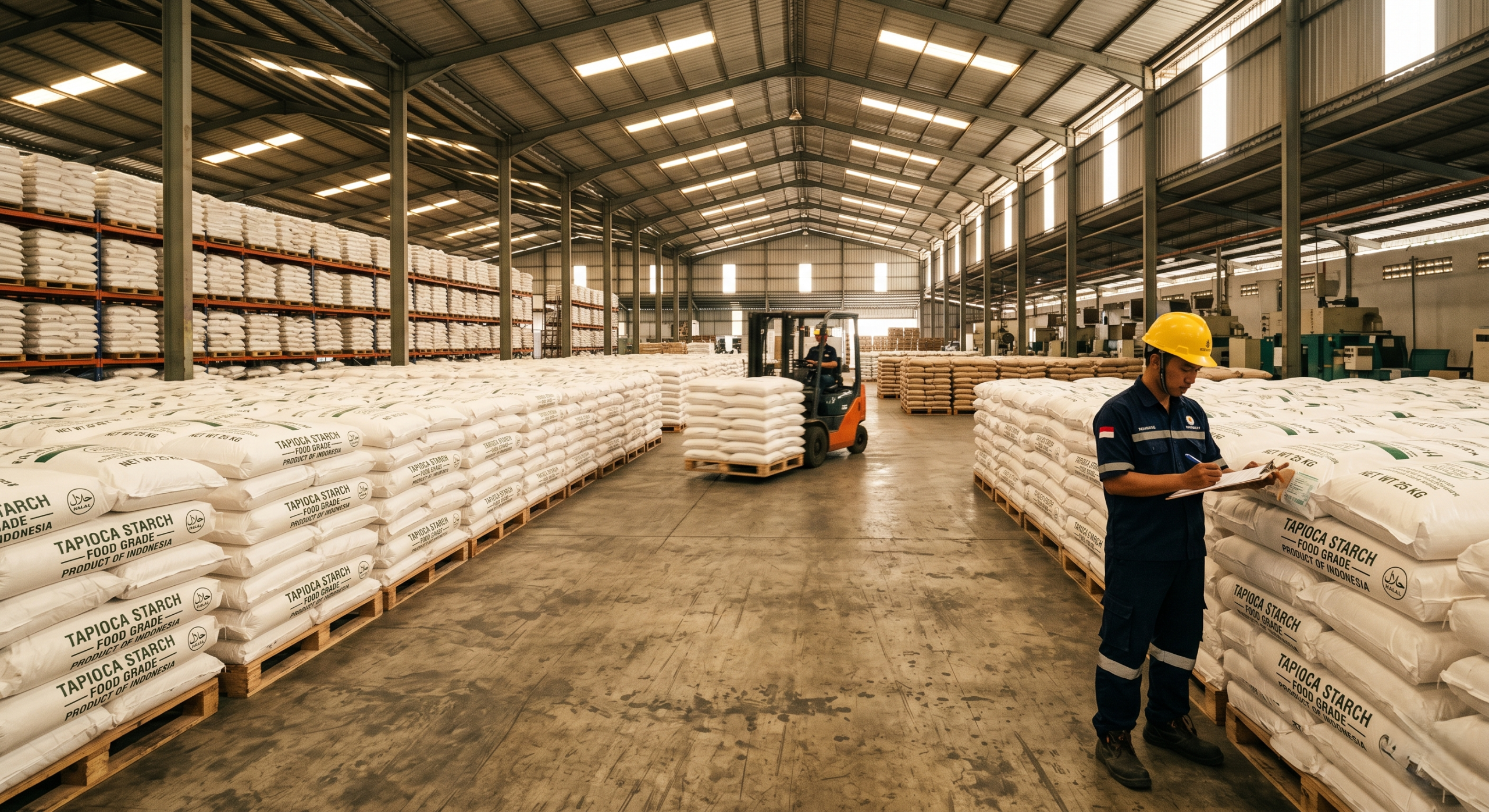
Indonesia is a highly reliable source for bulk tapioca starch due to its year-round cassava harvesting cycle, and strict compliance with international food safety standards like FSSC 22000, Halal, and non-GMO protocols.
Unlike regions that suffer from harsh winter interruptions or defined monsoonal stop-periods, Indonesia’s equatorial climate allows for a unique, continuous agricultural cycle.
Year-Round Harvesting: Cassava (Manihot esculenta) roots are harvested and processed non-stop throughout the year. This eliminates the massive seasonal price spikes and artificial scarcity often seen in single-harvest origins.
Freshness and Viscosity: Because processing facilities operate adjacent to cultivation clusters, roots move from harvest to extraction within 24 hours. This rapid turnaround prevents enzymatic degradation, preserving peak viscosity and excellent whiteness indices in the finished starch.
A premium product is only as good as the infrastructure moving it. When vetting Indonesian suppliers, procurement managers should map out the exact logistical corridor from the mill to the destination port.
Indonesia has invested heavily in its maritime logistics. The majority of bulk starch exports clear through major automated hubs, such as Tanjung Priok in Jakarta. These ports feature regular, direct container line routes to major European, North American, and Asian ports, reducing transshipment risks and keeping transit lead times highly predictable.
To clear international customs smoothly and satisfy corporate compliance mandates, your Indonesian starch supply must possess fully validated paperwork. Do not move forward without verifying the following credentials:
Ensure the processing mill is certified under a Global Food Safety Initiative (GFSI) recognized scheme. FSSC 22000 certifications guarantee that the facility operates with rigorous allergen controls, strict microbiological boundaries, and automated foreign-body detection (magnets and metal detectors).
Indonesia houses the world’s most advanced Halal certification network (BPJPH/MUI), which maintains strict mutual recognition agreements with global bodies. Additionally, ensure the supplier provides documented Kosher compliance and explicit Non-GMO project validation to simplify your front-of-pack consumer claims.
Commercial viability relies heavily on understanding shipping minimums and packing efficiencies. Sourcing from Indonesia typically adheres to structured commercial guidelines:
Minimum Order Quantities (MOQs): For international sea freight, the standard entry baseline is one Full Container Load (1 FCL). This typically equates to 18 to 20 metric tons when utilizing 20-foot dry van containers, depending on weight-limit restrictions at the destination port.
Packaging Modalities: Starch is typically packed in multi-wall paper bags or woven PP bags of 25 kilograms for manual handling. For automated factories, 850kg or 1,000kg Jumbo Bags (FIBC) are highly recommended to cut down on unloading times and waste disposal costs.
| Sourcing Parameter | Standard Specification | Procurement Impact |
| Minimum Order Quantity | 1 FCL (18 – 20 Metric Tons) | Maximizes ocean freight efficiency per kilogram. |
| Primary Export Ports | Tanjung Priok (Jakarta) | Direct routes ensure stable, predictable transit timelines. |
| Baseline Certifications | FSSC 22000, Halal, Kosher | Guarantees friction-free customs clearance and audit safety. |
| Harvest Availability | Continuous 12-Month Cycle | Eliminates seasonal price spikes and contract defaults. |
Securing a transparent, resilient supply chain from Southeast Asia requires an onshore partner who speaks the language of international quality control. Blue Highcrest bridges the gap completely, serving as your trusted partner for high-purity Indonesian tapioca starch sourcing.
We operate with full transparency. Blue Highcrest manages the entire sourcing matrix—from checking farm-level traceability and auditing batch-specific Certificates of Analysis (COAs) to managing complex container logistics and port clearances. When you secure your starch supply through us, you get consistent technical performance, locked-in pricing structures, and zero cross-border communication friction.
Protect your manufacturing facility from supply chain shocks. Contact the procurement and logistics team at Blue Highcrest today to discuss our contract volume options, evaluate our export certifications, and request a comprehensive technical quotation.
[Contact us for an Indonesian Sourcing Quote]
Transit times vary by exact shipping lane. On average, shipments from Jakarta to major US West Coast ports take approximately 25 to 30 days, while shipping to major European ports (like Rotterdam) averages 30 to 35 days under standard shipping conditions.
We source exclusively from advanced Indonesian mills utilizing modern extraction technology. Every batch is rigorously tested using a Rapid Visco Analyzer (RVA) to verify that peak viscosity, paste clarity, and moisture parameters match your technical data sheet precisely before loading.
Yes. Tapioca starch features a lower gelatinization temperature and a clearer, more neutral flavor profile than corn starch. It serves as an excellent clean-label, gluten-free replacement for binding, texturizing, and thickening in sauces, dairy, and bakery items.
Indonesia benefits from various regional and bilateral trade agreements. Depending on your destination country and specific Harmonized System (HS) code classifications, sourcing from Indonesia can offer significant tariff savings compared to other global starch origins.