
The allergen-free food category is no longer a niche market. Across the European Union, the United Kingdom, and the United States, “free-from” product positioning has moved from specialty health stores into mainstream retail channels, school foodservice contracts, and institutional procurement streams.
For food manufacturing companies, this shift creates an intense formulation challenge. Wheat flour is deeply embedded in industrial production processes. Its gluten network provides the vital structure, elasticity, water absorption, and gas retention that few singular ingredients can easily replicate.
Cassava flour is an effective allergen-free wheat flour substitute because its natural fiber and starch matrix closely mimics the water absorption, binding capacity, and texture of wheat. It is completely free of major global allergens, features a highly neutral flavor profile, and functions at a 1:1 replacement ratio in most non-yeast applications.
Regulatory frameworks dictate mandatory allergen labeling worldwide. The EU’s food information regulations require clear declarations for 14 major allergens, with wheat at the top of the list. In the US, the FDA mandates labeling for 9 major allergens. For manufacturers supplying retail chains, hospital kitchens, or international export markets, an allergen-free formulation has become a critical baseline requirement.
Removing wheat from a commercial recipe can dismantle its functional performance. Many common substitutes resolve only one or two functional parameters while introducing distinct manufacturing drawbacks:
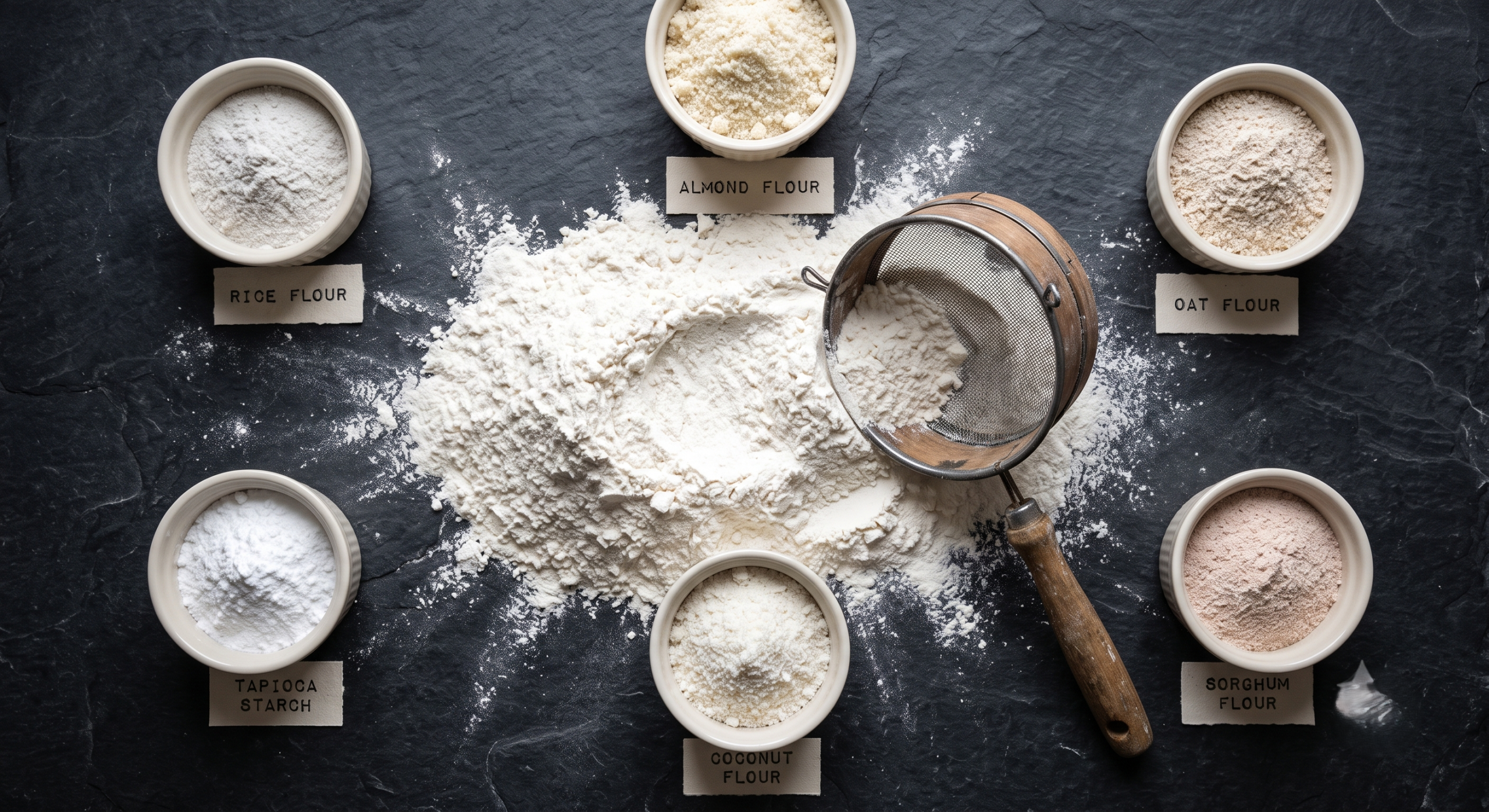
Rice Flour: Offers low ingredient costs but frequently yields a gritty mouthfeel and poor binding properties.
Oat Flour: Carries a high risk of field and facility cross-contamination, which can disqualify finished products from certified gluten-free status.
Almond Flour: Is itself a major tree nut allergen, adds heavy fat density, and introduces significant raw material price volatility.
Sorghum and Coconut Flours: Present distinctive flavor profiles or highly erratic hydration behaviors that complicate automated manufacturing lines.
High-quality cassava flour resolves these operational challenges simultaneously without compromising clean-label ingredient decks.
Produced by peeling, drying, and milling the whole cassava root, cassava flour undergoes a simple processing sequence that retains the root’s natural complex carbohydrates and structural fibers. This yields a fine-textured, white flour with functional behaviors that align closely with traditional wheat systems.
Cassava flour is naturally free from all 14 EU-regulated and all 9 US major allergens. It contains zero gluten, soy, dairy, egg, tree nuts, peanuts, sesame, or grain proteins. Utilizing a single, inherently safe ingredient allows processing plants to simplify cross-contamination management protocols on shared production lines.
Unlike isolated starches that exhibit poor water binding, the natural fiber fraction within whole-root cassava flour manages moisture similarly to wheat. In standard baking trials, cassava flour typically functions at a direct 1:1 substitution ratio by weight, requiring only a minor 10% to 15% increase in liquid inputs to compensate for its consistent absorption characteristics.
Consumer testing panels consistently rate cassava flour as highly flavor-neutral. It lacks the intense bean notes of pulse flours or the heavy cereal profile of alternative grains. This allows industrial bakeries to convert existing product lines to allergen-free versions while matching the original, expected consumer flavor profile.
While cassava flour serves as an exceptional drop-in substitute across many product lines, distinct application boundaries require precise R&D calibration:
Yeast-Leavened Bread: Because cassava lacks gluten proteins, it cannot naturally trap carbon dioxide during fermentation. To prevent a dense, heavy crumb structure, R&D teams should pair cassava flour with clean-label hydrocolloid binders like psyllium husk or xanthan gum to replicate gas retention.
High-Expansion Extruded Puffs: The native fiber in whole cassava flour can limit the expansion ratio in high-velocity twin-screw extruders. For optimal cell structure and crunch, engineers should blend cassava flour with pure tapioca starch at ratios between 40:60 and 60:40.
High-Elasticity Doughs: Applications requiring extreme elasticity, such as thin-film pasta or laminated pastry doughs, require structural support. Incorporating 1% to 2% psyllium husk provides the necessary tensile strength without altering the clean-label status.
| Food Application | Cassava Flour Performance | Rice Flour Alternative | Almond Flour Alternative |
| Tortillas & Wraps | Excellent; maintains high flexibility and a 1:1 replacement ratio. | Poor; brittle sheets prone to cracking during rolling. | Poor; heavy fat matrix prevents thin structural sheets. |
| Crackers & Flatbreads | Excellent; achieves a crisp, uniform sheet texture. | Good; but can introduce surface checking and breakage. | Poor; yields a soft, oily bite rather than a clean snap. |
| Battered Coatings | Excellent; provides superior adhesion and crispness. | Acceptable; but prone to high oil absorption during frying. | Poor; burns quickly due to high native protein/fat levels. |
| Cookies & Shortbreads | Excellent; matches traditional melt-in-mouth textures. | Acceptable; often leaves a lingering sandy or gritty texture. | Good; but significantly alters the product’s nutritional profile. |
Beyond retail product development, cassava flour offers a powerful operational case for institutional food producers, private label manufacturers, and large-scale foodservice operators.
School meal programs and transport catering operations must frequently fulfill allergen-safe menus by default. Sourcing a single flour that functions across multiple stock-keeping units (SKUs)—from protein coatings to baked goods—significantly reduces supplier management overhead and recipe complexity. Furthermore, its clean ingredient declaration (“cassava flour”) satisfies consumer and regulatory demands for simple, recognizable ingredients over chemically modified alternatives.
To ensure absolute consistency across high-volume production cycles, procurement managers must evaluate specific quality indicators during the vendor qualification phase:
Moisture Thresholds: Insist on a maximum moisture content of 12% (with an ideal target specification of 10% to 11%). This baseline prevents microbial activity and ensures predictable water absorption behavior on automated mixing lines.
Allergen Documentation: Verify that your supplier provides batch-level laboratory testing confirming gluten concentrations safely below the 20 ppm Codex standard, backed by dedicated facility audits.
Logistical Lead Times: Bulk shipments originating from key Southeast Asian cultivation hubs generally require a 4-to-8-week transit window to western ports. Procurement departments should maintain a 6-to-8-week safety stock buffer during initial supply chain integration.
Maintaining an efficient, high-throughput production line requires raw material inputs that perform identically from batch to batch. Blue Highcrest supplies premium, industrial-grade cassava flour directly from top Indonesian processing facilities, engineered specifically to handle the rigors of automated manufacturing.
We eliminate supply chain variability. Our cassava flour is monitored for precise particle size distribution, low ash parameters, and strict moisture control. Blue Highcrest delivers full import documentation, robust traceability, and verified batch-level testing to ensure your lines run smoothly, your labels remain fully compliant, and your margins are thoroughly protected.
Don’t let raw material inconsistencies cause line downtime or product defects. Contact the industrial sourcing team at Blue Highcrest today to receive complete technical data sheets, compliance certifications, and to secure a production-scale sample for your next R&D trial.
In the vast majority of non-yeast applications—including cookies, crackers, tortillas, pancakes, and battered coatings—yes. It substitutes at a 1:1 ratio by weight, though formulators typically add 10% to 15% more water to account for its natural fiber absorption.
Cassava flour is produced from the whole, dried root vegetable, preserving its native fiber, protein, and complex carbohydrate structures. Tapioca starch is isolated through a wet-extraction process that removes all fiber and protein, leaving behind only the pure starch fraction. They behave differently in industrial formulations.
Yes. Cassava is a tuberous root vegetable, not a cereal grain. This status allows brand marketing teams to utilize premium packaging claims such as grain-free, paleo, and gluten-free simultaneously on a single product label.
Our mills utilize advanced, automated flash-drying systems and rigorous sorting protocols immediately post-harvest. Every bulk container is accompanied by a comprehensive Certificate of Analysis (COA) detailing strict adherence to international microbiological safety limits.