
For procurement managers and production directors, buying raw ingredients at a great price is only half the battle. How those ingredients arrive at your loading dock plays a massive role in your daily factory costs. If you order thousands of small bags when your factory is built for bulk totes, you will waste thousands of dollars on manual labor, slow down your mixing lines, and create mountains of trash. On the other hand, ordering massive bulk bags without the right lifting machines can bring your warehouse to a complete stop.
Whether you are buying cassava flour, native tapioca starch, pea protein isolate, or soluble fibers, matching your packaging format to your production volume is critical. By looking closely at how your workers move, open, and mix your ingredients, you can pick the right packaging to speed up your factory floor and protect your profit margins.
Direct Answer: Choosing the right ingredient packaging depends on your monthly volume and factory equipment. Standard 25kg bags are best for smaller batches, pilot runs, and manual loading. Jumbo bags (500kg to 1,000kg) are ideal for medium-to-large factories with forklifts and overhead hoists, cutting down on labor and dust. Full bulk container liners are built for high-volume factories that blow dry powders directly into giant storage silos.
The standard 25kg (or 50lb) bag is the most common packaging format in the food industry. These bags are usually made of strong, multi-layer kraft paper or woven plastic with a food-safe inner liner to keep moisture out.
For growing food brands, test kitchens, and factories running smaller batch sizes, 25kg bags offer great flexibility. You do not need special overhead cranes or expensive dumping machines to use them. A single factory worker can easily lift a bag, slice it open, and pour the cassava flour or pea protein directly into a mixing bowl. They are also easy to stack on pallets and store in tight warehouse spaces.
However, once your factory grows to produce tens of thousands of units a day, 25kg bags become a major bottleneck. If a single batch recipe needs 500 kilos of tapioca starch, a worker has to manually lift, cut, and dump 20 separate bags. This causes heavy worker fatigue, creates a lot of airborne dust, and increases the risk of pieces of torn paper falling into your food. You also have to pay to haul away hundreds of empty bags every week. Moving away from manual bag dumping is one of the biggest steps when taking a gluten-free baking premix to commercial scale.
When your factory outgrows manual bag dumping, the next step up is the jumbo bag—often called a “super sack,” tote bag, or FIBC (Flexible Intermediate Bulk Container). These large, heavy-duty woven plastic bags hold anywhere from 500kg to 1,000kg (one metric ton) of dry powder.
Jumbo bags are the sweet spot for most mid-to-large food manufacturers. Instead of paying workers to cut open 40 small bags to get one ton of flour, a forklift driver simply picks up a single jumbo bag by its corner loops and hangs it on a steel frame above your mixer. A worker unties the bottom spout, and the powder flows cleanly into the closed mixing tank through a pipe.
Switching to jumbo bags delivers huge operational benefits:
Lower Labor Costs: One forklift movement replaces 40 manual heavy lifts, saving hours of setup time every day.
Cleaner Factory Air: Because the bottom spout connects directly to your hopper, almost no flour dust escapes into the air. This keeps your floor clean and protects your workers’ lungs.
Less Packaging Waste: One empty jumbo bag can be folded up and recycled easily, eliminating dumpsters full of torn paper bags.
Lower Ingredient Prices: Because it takes less time and material for the supplier to fill one big bag instead of 40 small ones, you often get a better price per ton.
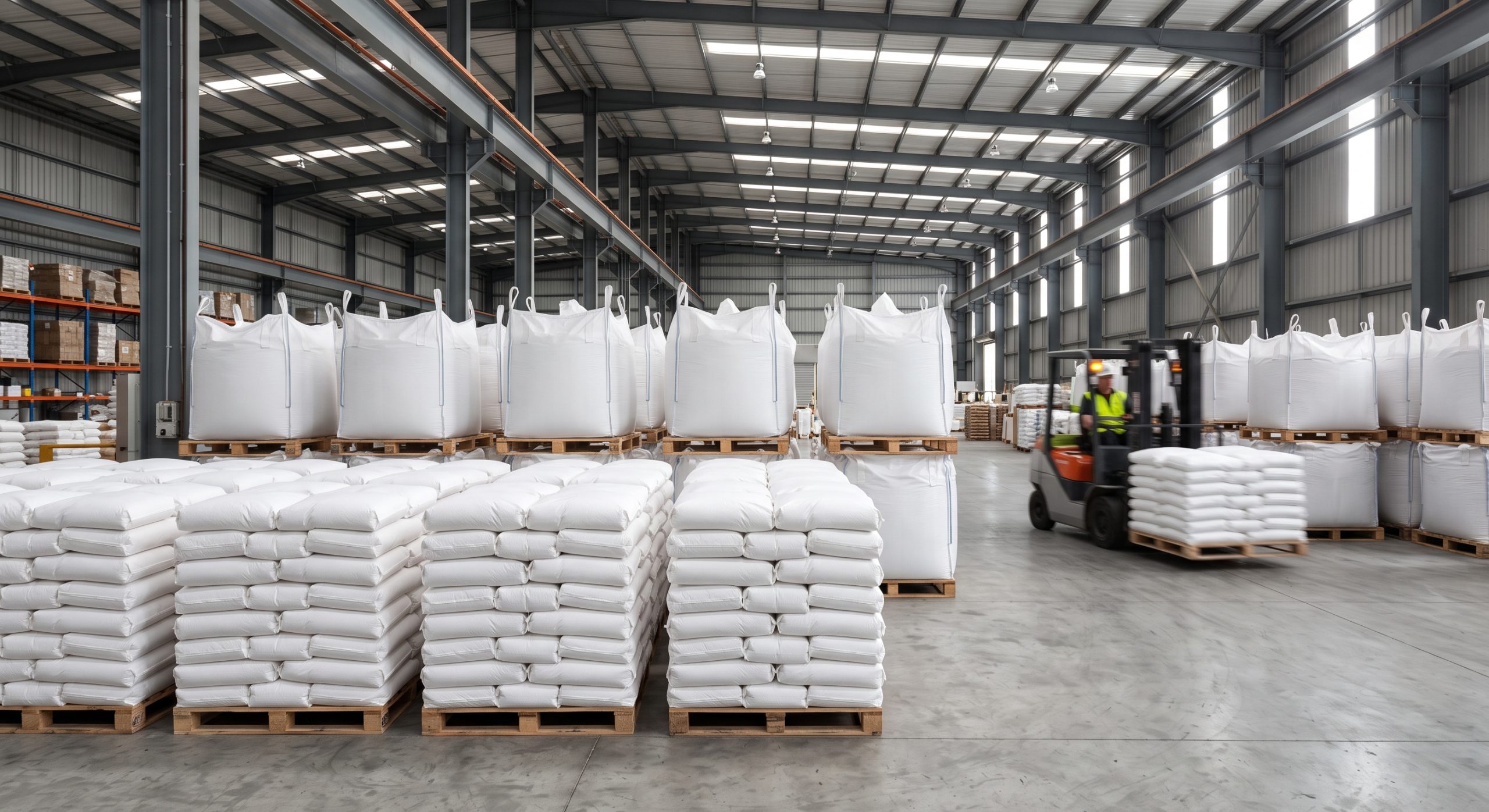
For massive industrial bakeries, snack factories, and extrusion plants that go through multiple shipping containers of tapioca starch or cassava flour every week, even jumbo bags are too slow. These mega-factories use dry bulk container liners (often called “sea bulk” liners).
A bulk liner is a giant, food-grade plastic bag that fits inside an entire 20-foot or 40-foot ocean shipping container. At the source mill, up to 20 metric tons of starch are blown directly into the liner. When the container arrives at your factory, a special truck tilts the container up and uses air pressure to blow the powder through a hose straight into your outdoor storage silos. No workers ever touch a bag, and you use 100% of the shipping container’s space without paying to ship heavy wooden pallets.
If you are buying liquid ingredients like soluble tapioca fiber or soluble corn fiber syrups your packaging choices work the same way. IBC totes can be moved easily with a forklift, stacked to save floor space, and hooked directly up to your liquid pumping lines with a simple valve.
To help your procurement and production teams pick the best option, compare your factory setup against this simple packaging table:
| Packaging Format | Best Monthly Volume | Factory Equipment Needed | Labor & Dumping Speed | Dust & Waste Control |
| 25kg Paper / PP Bags | Under 5 to 10 Tons | Basic pallet jack and box cutter | High labor (slow manual lifting and cutting) | Poor (creates dust and lots of empty bag trash) |
| 500kg – 1,000kg Jumbo Bags | 10 to 100+ Tons | Forklift and overhead hoist frame | Low labor (fast, semi-automated spout unloading) | Excellent (closed-loop pouring and minimal waste) |
| Dry Bulk Container Liner | 100+ Tons | Outdoor storage silos and air-blower trucks | Zero manual labor (fully automated air pumping) | Perfect (100% sealed system with zero bag waste) |
| 1,000L Liquid IBC Totes | 5+ Tons (Syrups) | Forklift, warming jacket, and liquid pump | Low labor (connect hose to bottom valve) | Excellent (reusable or recyclable cage tanks) |
Choosing the right bag size is not just about factory speed; it is also about keeping your food safe while it travels across the ocean. Shipping containers go through extreme heat and high humidity during transit. If your packaging is weak, moisture will ruin your ingredients before they ever reach your warehouse.
Dry powders like soluble corn fiber powder and pea protein isolate are very “hygroscopic,” meaning they act like a sponge and suck moisture right out of the air. If moisture gets inside the bag, the entire batch will harden into a solid brick. To prevent this, you must make sure your supplier uses high-barrier, food-grade polyethylene (PE) inner liners inside both 25kg bags and jumbo bags. Checking these packaging details is a vital step when you evaluate tapioca starch supplier quality.
Furthermore, procurement teams need to decide between palletized and floor-loaded containers. Putting bags on heat-treated wooden pallets (or plastic slip-sheets) makes unloading at your dock take only 30 minutes with a forklift. Floor-loading (stacking bags by hand from floor to ceiling without pallets) lets you squeeze 2 to 3 extra tons of product into the container to save on shipping costs, but your workers will have to spend hours unloading the box by hand. You can learn more about maximizing container weights in our tapioca starch sourcing and procurement guide for Indonesia.
Always make sure to write your exact pallet height limits, bag weight limits, and liner requirements clearly in your initial purchasing documents. If you need help setting up these rules, review our guide on how to write a food ingredient supplier brief for quotes and samples.
Getting the highest quality ingredients in the exact packaging format your factory needs should be simple. Blue Highcrest supplies global food manufacturers with premium cassava flour, native tapioca starch, soluble fibers, and pea protein isolate tailored to fit your exact warehouse and mixing setup.
Our flexible packaging and logistics solutions offer:
Custom Format Options: Available in strong 25kg multi-wall bags, 500kg to 1,000kg spouted jumbo bags, and 1,000L liquid IBC totes.
Moisture-Lock Liners: Every bag is protected with heavy-duty, food-grade inner liners to stop clumping and keep moisture out during ocean shipping.
Custom Palletizing: Choose between floor-loaded containers for maximum volume or ISPM-15 heat-treated pallets wrapped tightly for fast, safe forklift unloading.
Ready to lower your factory labor costs and streamline your ingredient deliveries? Contact the logistics and sales team at Blue Highcrest to request commercial samples, full packaging specification sheets, and bulk container pricing.
In a standard 20-foot shipping container,wooden pallets take up valuable space and weight. A palletized container usually holds around 16 to 18 metric tons of bagged flour or starch. A floor-loaded container (where bags are stacked directly on the floor) can hold up to 19 to 22 metric tons, helping you lower your shipping cost per kilo.
Soluble tapioca and corn fiber powders absorb moisture from the air very quickly. To stop clumping, order jumbo bags that have a thick, heat-sealed inner plastic (PE) liner. In your factory, only untie the spout when connected to your hopper, and tightly re-tie the inner liner immediately if you do not use the whole bag at once.
In cold warehouses, liquid fiber syrups become very thick and slow to pour. Commercial factories wrap a simple electric IBC heating blanket (warming jacket) around the outside of the tote for a few hours before use. Warming the syrup slightly makes it thin and easy to pump into your mixing tanks.
Yes. We work directly with our buyers to include custom lot codes, barcodes, allergen warnings, and specific storage instructions on the outside of every bag so your warehouse team can scan them straight into your inventory system.