
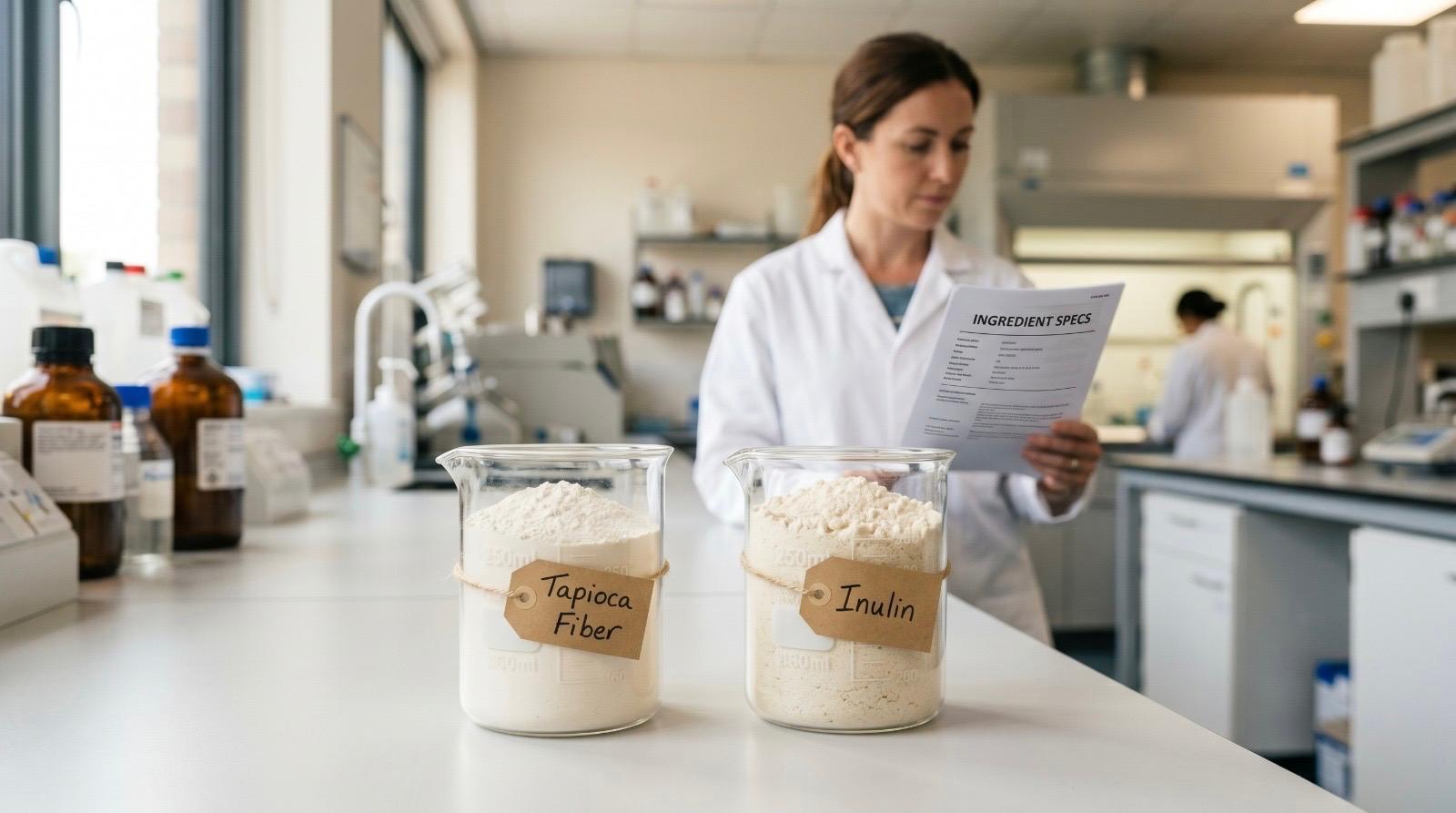
If your RnD team is under pressure to hit a fiber claim on the nutrition panel without triggering consumer complaints, destabilizing your formula, or adding an unclean ingredient to the label, you’ve likely already looked at both inulin and soluble tapioca fiber.
Both are functional, both are prebiotic, and both can add dietary fiber to your finished product. But they behave very differently inside a manufacturing process, and choosing the wrong one can cost you in reformulation time, consumer returns, or failed shelf-life testing. This article breaks down exactly where each fiber performs, where each falls short, and which applications call for which ingredient.
Soluble tapioca fiber — also known as resistant dextrin from tapioca — is a dietary fiber derived from cassava root starch through a controlled enzymatic and thermal process. The result is a highly branched, water-soluble fiber with a neutral taste, low viscosity, and excellent compatibility across a wide range of food and beverage applications.
The global soluble tapioca fiber market reflects a growing shift in manufacturer preference. It was valued at approximately USD 412.7 million in 2024 and is projected to reach USD 821.4 million by 2033, expanding at a compound annual growth rate of 7.8%. This isn’t just a consumer trend — it’s formulation strategy. Procurement teams and food technologists are actively sourcing it because it solves processing problems that inulin doesn’t.
The cassava plant, cultivated at scale across Southeast Asia, provides a non-GMO, clean-label raw material base with stable, year-round supply. For European, UK, and US manufacturers, the key question isn’t whether soluble tapioca fiber works — it’s whether your supplier can back it up with the documentation your import and compliance teams require.
Inulin has been a staple functional fiber for decades, and for good reason. Extracted primarily from chicory root, it delivers genuine prebiotic benefits, supports gut microbiota, provides mild fat-mimicking properties, and contributes a creamy mouthfeel — particularly useful in dairy alternatives and nutrition bars at moderate inclusion rates.
For specific formulations, inulin remains a competent choice. Products at neutral pH, processed under moderate heat, and with fiber inclusions below 5% can work well with it. But inulin carries three well-documented limitations that become operationally critical at scale.
The first is digestive tolerance. Inulin belongs to the FODMAP family of fermentable carbohydrates and is one of the most commonly problematic FODMAPs in clinical intolerance testing. Research on yogurts formulated with inulin found that inclusions of 7% and 13% produced statistically significant bloating and flatulence compared to a control. For a brand making a high-fiber nutrition bar or functional beverage targeting gut-health-conscious consumers, this is not a footnote — it’s a product return risk.
The second is heat and pH instability. Inulin undergoes acid- and heat-catalyzed hydrolysis beginning around 135–150°C, fragmenting into shorter-chain fructans and free fructose, which accelerates Maillard browning and reduces functional bulk. In acidic products or those subjected to UHT treatment, retorting, or standard baking temperatures, inulin’s functional contribution degrades in ways that your original formulation testing won’t capture.
The third is FODMAP positioning. As more manufacturers develop products targeting IBS-sensitive, low-FODMAP, or gut-health-specific consumer segments, inulin’s classification becomes a labeling liability rather than a selling point.
Soluble tapioca fiber’s molecular structure — predominantly resistant maltodextrins with controlled branching — gives it a substantially wider processing window than inulin. Here is where the difference matters most in practice.
Thermal and pH stability. Resistant tapioca dextrin remains stable under high-temperature processing conditions up to 250°C and in acidic pH environments, making it functionally superior to inulin in demanding manufacturing settings. Documented stability runs from pH 2 to 7, covering everything from acidic RTD beverages to fermented dairy products, with fiber content maintained through UHT and baking operations.
Digestive tolerance at higher inclusion rates. The metabolic rate of soluble tapioca fiber is relatively slow, leading to sustained energy release — in contrast to inulin, which is rapidly fermented in the colon due to its shorter chain length. This slower, gentler fermentation means manufacturers can target higher fiber levels per serving — 8g, 10g, even 12g — without the bloating risk that limits inulin’s ceiling.
Sensory and solubility profile. Soluble tapioca fiber dissolves readily at room temperature, produces a clear solution, and carries a genuinely neutral taste — no off-notes, no sweetness creep. For transparent beverages, clear protein drinks, and premium supplement formulations where sensory purity is non-negotiable, this matters enormously.
Clean-label fit. As a single-ingredient fiber derived from tapioca starch and recognized as safe by the FDA (GRAS), EU, and UK regulatory frameworks, it adds nothing to the ingredients list that a clean-label shopper will question.
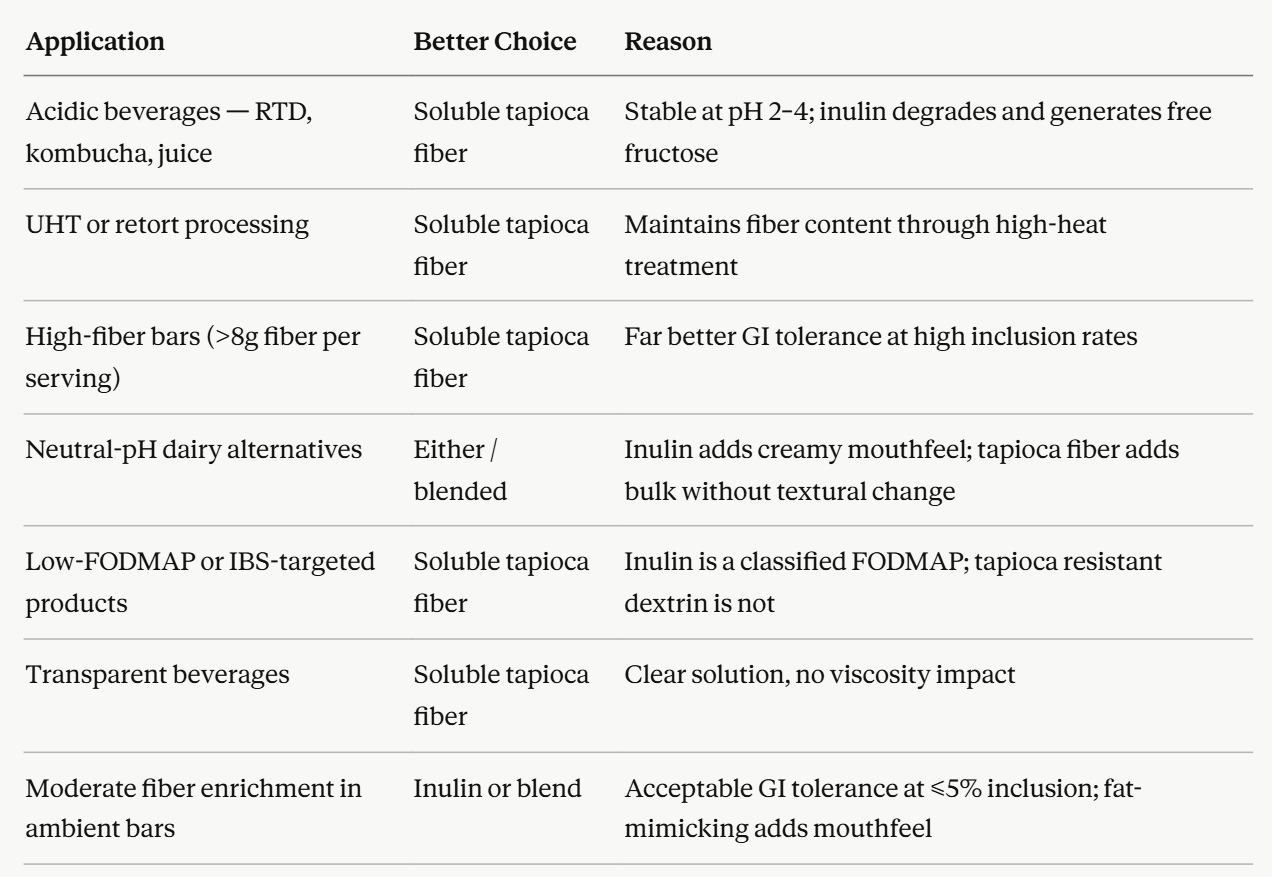
One practical note: for manufacturers who want the prebiotic depth of inulin alongside the processing versatility of tapioca fiber, a stacked fiber approach is viable. Using both at lower individual inclusion rates lets you maximize your fiber claim while staying inside digestive tolerance thresholds for both.
Beyond the formulation comparison, sourcing decisions come down to supply reliability, import documentation, and cost predictability — especially for manufacturers bringing ingredients into the EU, UK, or US.
Chicory inulin supply is subject to crop-year variability. European chicory harvests have historically driven pricing swings of 15–30% in a single season, and procurement teams at manufacturers relying on a single inulin source have felt that directly in contract renewals.
Soluble tapioca fiber sourced from Southeast Asia — where cassava is cultivated at commercial scale year-round — offers more predictable volume availability and more stable pricing curves. That supply consistency matters as much to a category manager building a 12-month cost model as the technical spec sheet matters to the food technologist.
At Blue Highcrest, we supply soluble tapioca fiber from Indonesia with full documentation ready for EU, UK, and US import: Certificate of Analysis, MSDS, phytosanitary certificates, and halal certification where applicable. We work with procurement teams, RnD leads, and supply chain directors who need an ingredient partner that can support both trial volumes and full manufacturing runs — without the documentation gaps that slow down import clearance.
Inulin is not obsolete. For specific applications at moderate inclusion rates and under controlled pH and temperature conditions, it remains a well-understood, effective ingredient. But for manufacturers targeting high fiber claims, acidic or high-heat product formats, sensitive consumer segments, or clean-label positioning without compromise, soluble tapioca fiber from a traceable cassava source offers a more formulation-flexible and operationally predictable alternative.
The choice isn’t always either/or but understanding where each fiber performs is the difference between a product that works at scale and one that gets reformulated after the first round of consumer feedback.
Ready to evaluate soluble tapioca fiber for your next formulation? Blue Highcrest offers sample quantities with full technical data sheets and COA included. We respond within one business day. Contact Our Ingredient Team
bluehighcrest.com — Functional Ingredients for Food & Beverage Manufacturers in Europe, the UK, and the United States.