
For R&D food engineers and technical directors in the savory snack sector, mastering the physical physics of the cooking extruder is vital to product success. Consumer acceptance of an extruded puff, ring, or chip relies almost entirely on its acoustic and structural texture—the “crunch factor.”
As brands transition away from corn and wheat to fulfill gluten-free and grain-free clean-label mandates, high-quality cassava flour (HQCF) has become a primary structural base. However, replacing traditional cereal grains with a tuber matrix fundamentally alters rheological behavior inside the barrel. Achieving an optimal cell structure and expansion ratio requires precise control over cassava’s distinct gelatinization properties and mechanical shear parameters.
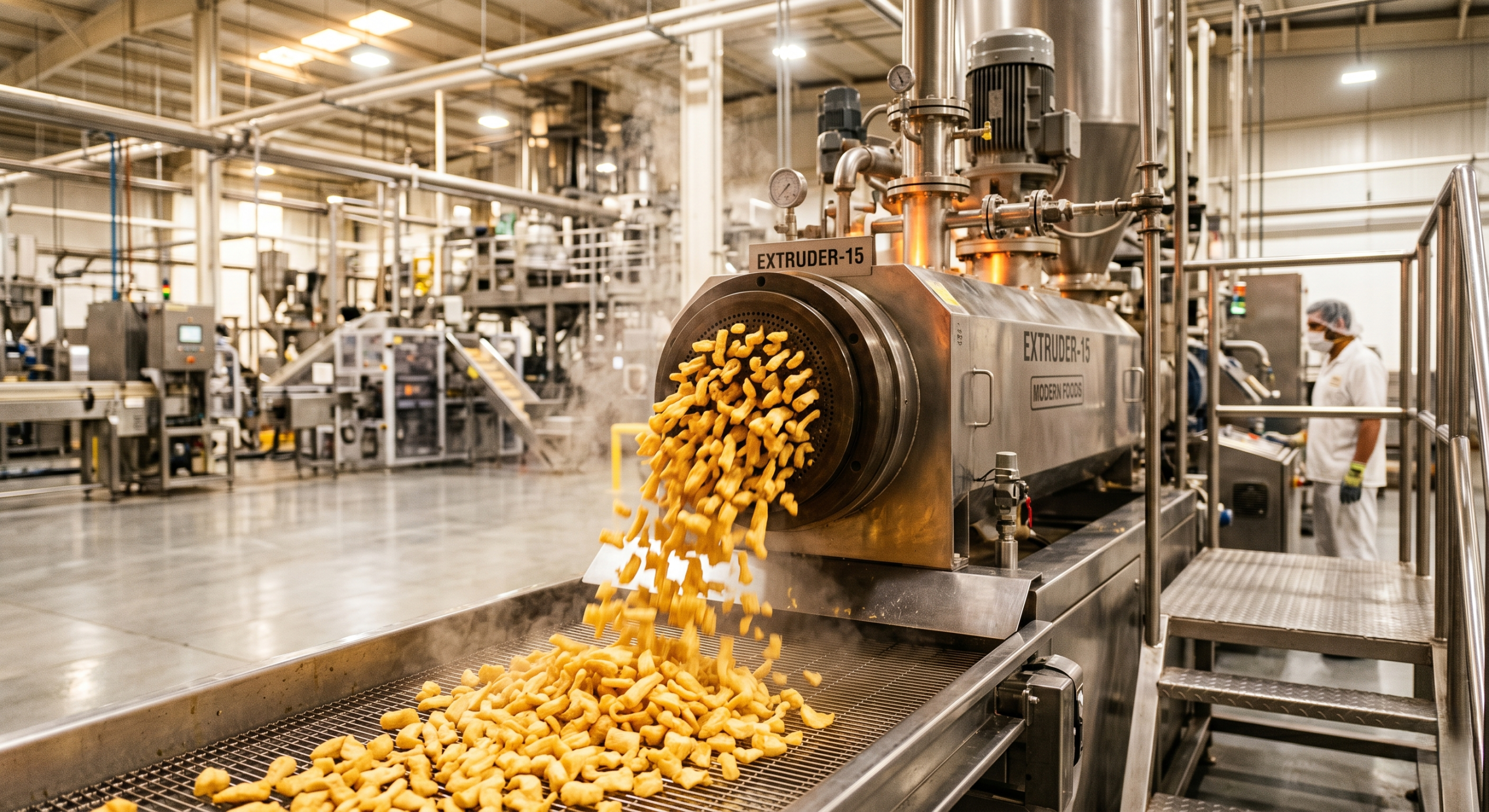
To optimize crunch in cassava flour extrusion, maintain barrel temperatures between 90°C and 120°C to match its low gelatinization threshold (60°C–70°C). Adjust feed moisture to 14%–17% and configure high screw speeds (1,000–1,200 rpm) to generate sufficient mechanical shear. This creates a uniform, thin-walled cellular matrix that yields a crisp, non-hard bite.
To engineer a premium crunch, you must understand the molecular composition of your raw materials. Cereal starches (like corn and wheat) contain higher concentrations of lipids and proteins that restrict granule swelling. Cassava flour, conversely, is a highly pure tuberous carbohydrate matrix dominated by an amylopectin-heavy fraction.
This compositional variance yields distinct thermodynamic advantages and processing challenges:
Lower Gelatinization Temperature: Cassava starch granules undergo crystalline melting and rapid hydration at 60°C to 70°C, which is significantly lower than corn starch (typically 75°C to 80°C).
Rapid Viscosity Peaks: Cassava swells faster and reaches peak viscosity under less thermal energy. If your barrel thermal profile is configured too high early in the process, the starch will over-gelatinize and break down, resulting in a sticky, dense melt that clogs the die assembly.
The transition from a pressurized, molten starch melt inside the extruder barrel to an expanded snack at the die face is governed by thermodynamics. As the moisture-laden melt exits the die, the sudden drop to atmospheric pressure causes superheated water to instantly vaporize, creating a matrix of microscopic steam bubbles or “cells.”
[In-Feed: 14-17% Moisture] ──> [Melt Zone: 60-70°C Gelatinization] ──> [Die Exit: Sudden Depressurization] ──> [Optimized Crisp Matrix]
If the cell walls are too thick, the snack becomes dense and hard, presenting an unpalatable “glassy” texture that fatigues the jaw. If the cell walls are too thin, the structure collapses under its own weight, producing a crumbly, fragile puff that degrades into powder during automated seasoning and packaging runs. High-quality cassava flour provides the melt elasticity required to sustain thin, resilient cell walls that lock in an ultra-crisp acoustic crunch.
To successfully run high-quality cassava flour on single or twin-screw extrusion systems, your engineering team must balance three critical operational parameters:
Because cassava possesses a low gelatinization threshold, keep the feeding zone temperatures cool (40°C to 50°C) to prevent premature hydration and clumping. Gradually scale the cooking and compression zones to a peak barrel temperature of 90°C to 120°C. Exceeding 130°C can degrade the delicate amylopectin chains, causing severe viscosity breakdown and reduced expansion ratios.
Moisture acts as a primary plasticizer in extrusion cooking. For cassava-based formulations, maintain strict in-feed moisture parameters between 14% and 17%.
Too Low (< 12%): Generates excessive torque, overheating the starch melt and causing charring or uneven expansion.
Too High (> 19%): Decreases melt viscosity and vapor pressure at the die face, leading to poor lateral expansion and a soft, chewy product texture.
To compensate for cassava’s rapid swelling behavior, apply high specific mechanical energy via elevated screw speeds, typically ranging from 1,000 to 1,400 rpm depending on your equipment scale. High shear rates break down intact fibrous aggregates within the flour, ensuring a completely homogeneous melt that flows smoothly through complex die shapes.
| Process Variable | Target Range for Cassava | Technical Impact on Snack Quality |
| Gelatinization Zone | 60°C to 70°C | Initiates smooth crystalline melting; avoids starch degradation. |
| Peak Barrel Temp | 90°C to 120°C | Maximizes internal steam pressure without causing thermal breakdown. |
| In-Feed Moisture | 14% to 17% | Controls melt elasticity; establishes ideal cell wall thickness. |
| Screw Speed | 1,000 to 1,400 rpm | Delivers necessary SME to fully homogenize tuber fiber fractions. |
In high-throughput industrial manufacturing, raw material inconsistency is a primary driver of line downtime. A slight shift in the sand content, crude fiber, or moisture levels of your input flour can throw off your extruder’s automated torque algorithms, ruining an entire batch.
Blue Highcrest solves this operational pain point by supplying premium, industrial-grade High-Quality Cassava Flour specifically milled and standardized for high-shear extrusion lines.
Our cassava flour undergoes strict mechanical sifting to guarantee a uniform particle size distribution, eliminating oversized grains that can cause density variations in your melt matrix. With an exceptionally low moisture baseline, tight ash specifications, and guaranteed non-GMO verification, Blue Highcrest provides the structural consistency your R&D team requires to deliver an identical, optimized crunch across every single production shift.
Stop wrestling with unstable raw materials that stall your extrusion lines. Contact the industrial food engineering team at Blue Highcrest today to access full rheological profiles, rapid visco analyzer (RVA) charts, and to secure a dedicated production sample of our premium Cassava Flour.
[Request a Cassava Flour Technical Sample from Blue Highcrest]
Yes. High-quality cassava flour can serve as a 100% replacement for corn grits in expanded applications. It provides an identical expansion ratio and a significantly cleaner, more neutral flavor carrier for seasonings, though it requires slightly lower processing temperatures.
High ash content indicates the presence of residual minerals or impurities from inadequate root washing. These particles act as structural defects within the molten starch matrix, puncturing steam bubbles early and leading to dense, unexpanded regions in the finished snack.
If particle sizes vary widely, smaller particles gelatinize instantly while larger particles remain unhydrated at the core. This uneven hydration creates localized structural flaws in the melt, causing erratic expansion and an inconsistent crunch profile across the batch.
Absolutely. Our premium cassava flour is highly prized by pet food manufacturers developing premium, grain-free kibble and treats. Its excellent water-binding capacity and low gelatinization temperature help bind high-meat formulations efficiently while maximizing processing output.