
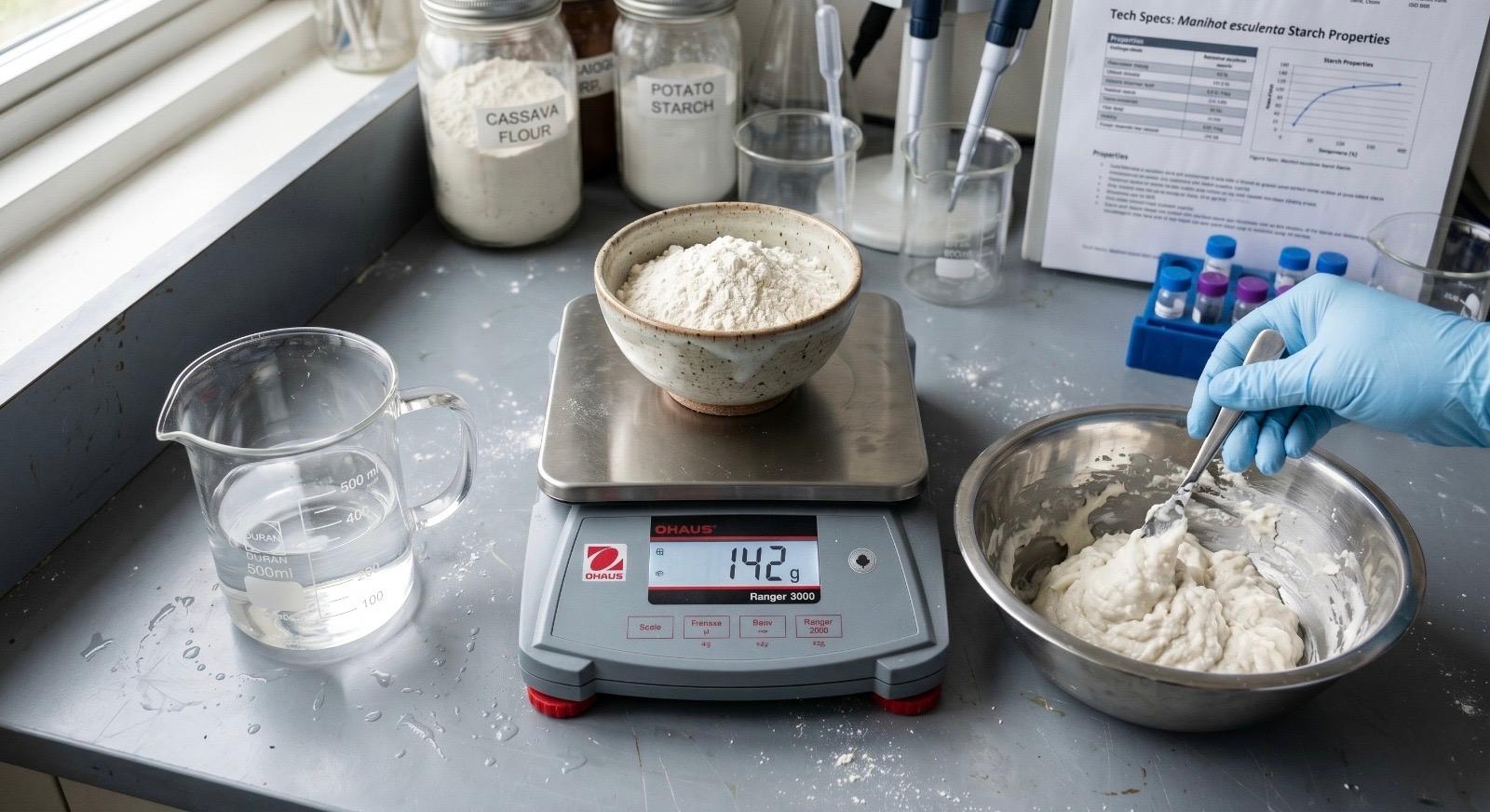
In the high-stakes world of commercial gluten-free (GF) R&D, the difference between a market-leading product and a formulation failure often rests on a single metric: the water absorption ratio. For food technologists, transitioning from wheat-based systems to cassava-based formulations requires a fundamental shift in rheological expectations.
Cassava flour is not a “drop-in” replacement for wheat; it is a complex carbohydrate matrix that interacts with moisture in distinct, high-performance ways. Understanding these technical specifications is critical for achieving the desired crumb structure, shelf-life stability, and dough handling properties.
Direct Answer: What is the Water Absorption Ratio of Cassava Flour?
The standard water absorption ratio for premium cassava flour typically ranges between 150% and 200% (1:1.5 to 1:2). This variance depends on starch damage, particle size, and amylose content. Optimal hydration occurs when the flour effectively encapsulates moisture to provide structural integrity without residual gumminess in GF applications.
Unlike wheat, which relies on a gluten protein network for structure, cassava flour relies on starch gelatinization and its unique fiber-to-starch ratio. When evaluating a cassava flour spec sheet, the Water Absorption Capacity (WAC) indicates the flour’s ability to hold water against gravity and processing pressure.
Particle Size (Granulometry): Finer mesh sizes (typically 80-100 mesh) increase the surface area, leading to faster hydration but potentially higher peak viscosity.
Starch Damage: During the milling process, physical damage to starch granules can increase water uptake. High-quality milling, such as that utilized by Blue Highcrest, ensures controlled starch damage for predictable R&D outcomes.
Amylose vs. Amylopectin Ratio: The ratio of these two glucose polymers dictates how the flour retrogrades (stiffens) after cooling. Higher amylose content generally leads to better structural stability in bread.
When developing a gluten-free formula, food technologists must balance the water-to-solids ratio to prevent “batter-like” doughs. Cassava flour presents a unique profile compared to rice or corn starch. By leveraging the higher absorption ratio of cassava, R&D teams can often increase their total yield per batch, provided the moisture is managed through proper hydrocolloid integration or temperature control.
| Flour Type | Typical Water Absorption | Rheological Impact |
| Premium Cassava Flour | 150% – 200% | High elasticity; excellent crumb moisture. |
| Rice Flour | 100% – 130% | Gritty texture; prone to syneresis. |
| Potato Starch | 200%+ | High peak viscosity; can become gummy. |
| Whole Wheat Flour | 60% – 75% | Reliant on gluten development. |
The “ideal” ratio shifts depending on the final application. For R&D trials, we recommend starting with the following baselines using Blue Highcrest Cassava Flour:
In yeast-leavened products, a 1:1.8 ratio is often the sweet spot. The high water absorption helps mimic the “spring” of gluten. Excessive water, however, leads to a “cave-in” post-bake. Precise measurement of the flour’s moisture content (ideally <12%) is necessary to calibrate this ratio.
For fats-heavy formulations, the water absorption ratio should be tighter—roughly 1:1.2. Here, the cassava flour must compete with lipids for moisture. A controlled absorption ensures the cookie maintains its “snap” rather than becoming overly soft or cake-like.
For extrusion, hydration must be uniform. A 30-35% total moisture content in the dough (incorporating the flour’s native moisture) is standard. Cassava’s ability to gelatinize quickly under heat makes it an elite candidate for GF pasta that maintains an al dente bite.
The greatest pain point for a food technologist is variability. If Batch A of your cassava flour has an absorption ratio of 160% and Batch B has 190%, your production line will face constant downtime for calibration.
Blue Highcrest solves this through rigorous supply chain control. Our cassava flour is processed to maintain:
Consistent Mesh Profiles: Ensuring uniform hydration across every pallet.
Low Moisture Volatility: Minimizing the “moving target” of water-to-flour ratios in your recipes.
Neutral Flavor Profiles: Allowing your R&D team to focus on the technical performance without masking “earthy” off-notes.
When conducting your initial bench-top trials, we recommend a staged hydration approach. Incorporate 80% of your calculated water initially, allowing the cassava flour to hydrate for 3-5 minutes before adding the final 20%. This “autolyse-lite” phase allows the starch granules to swell fully, providing a more accurate representation of the final dough viscosity.
Success in gluten-free innovation requires more than just a recipe; it requires a raw material that meets your exact technical specifications every time. Blue Highcrest provides high-purity cassava flour designed specifically for the rigorous demands of industrial food science.
Stop guessing your hydration ratios and start formulating with precision.
Are you ready to run a trial? Contact our technical sales team to request a 1kg or 5kg R&D sample and receive a full COA (Certificate of Analysis) including moisture and starch content.
Q: Does temperature affect the cassava flour water absorption ratio? A: Yes. Higher water temperatures (above 60°C) will initiate partial starch gelatinization, significantly increasing the absorption ratio and viscosity. For most GF doughs, ambient or chilled water is preferred to maintain handling properties.
Q: Can I replace xanthan gum if I use high-quality cassava flour? A: While cassava flour provides superior “cling” and elasticity compared to rice flour, most commercial applications still require a small percentage of hydrocolloids (0.5-1.5%) to support gas retention in leavened goods.
Q: How does the fiber content in cassava flour affect R&D? A: Higher fiber content generally increases water demand. Blue Highcrest’s flour is optimized for a low-fiber, high-starch profile to ensure a smooth, non-gritty mouthfeel in premium baked goods.
Q: What is the shelf life of the flour in a high-moisture formulation? A: Because cassava flour has high water activity once hydrated, we recommend using natural preservatives or pH adjusters if the final product has a high moisture content to prevent mold growth.