
Running a gluten-free menu program in a single restaurant is an operational challenge. Running one across a global fleet of 200 aircraft, serving 40,000 meals per day across 150 international routes, is a completely different category of problem. The same complexity applies to cruise lines operating multiple vessels, where each ship functions as a floating city serving thousands of guests across multi-week sailings with zero opportunity to restock mid-journey.
For food technologists, procurement directors, and catering operations managers, mass-scale allergen management is not a culinary consideration. It is a strict supply chain, ingredient specification, and production line control problem with direct legal liability exposure.
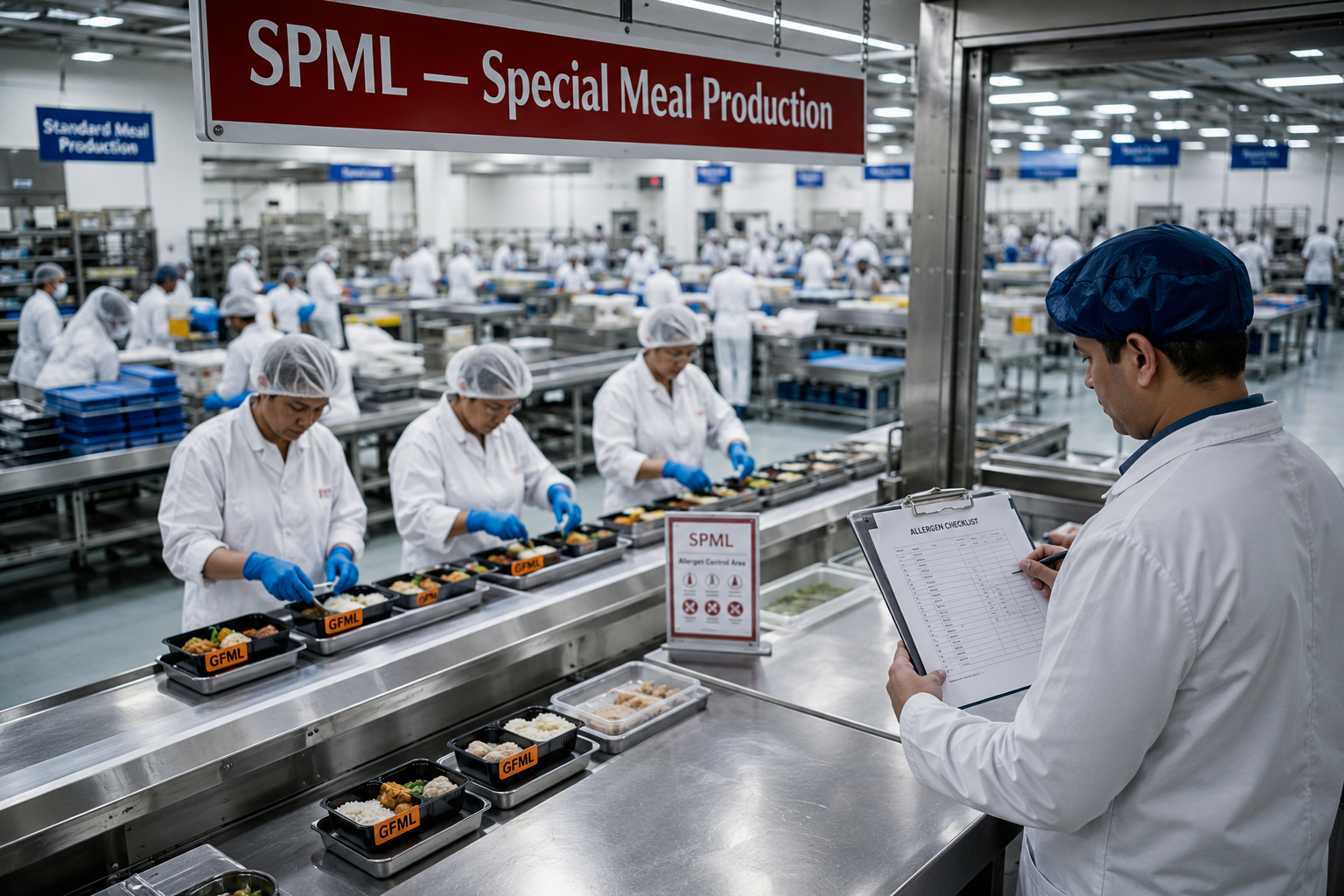
Airlines and cruise lines manage gluten-free menus at scale by isolating production streams into specialized diet kitchens and enforcing strict supply chain verification. Transitioning from complex blended substitutes to inherently allergen-free base ingredients like premium cassava flour and tapioca starch reduces cross-contamination risks across high-volume international catering networks.
A commercial airline operating a major hub network loads hundreds of special meals (SPMLs) daily. The Gluten-Free Meal (GFML) is consistently one of the most requested codes globally. These meals are prepared 12 to 48 hours in advance in contracted industrial catering facilities that serve dozens of airlines simultaneously from a single hub.
The gluten-free meal a passenger receives at 35,000 feet is produced in a high-throughput environment that also handles massive volumes of standard wheat-containing meals. The challenge is not the recipe itself. It is the cross-contamination control protocol, the raw material specification, and the supply chain traceability that allow the caterer to certify that the meal contains no gluten above legal regulatory thresholds.
For cruise lines, the challenge expands across multiple onboard dining venues operating at the same time. Provisioning occurs at international port calls where local supplier documentation standards vary. Chefs must maintain absolute allergen integrity across buffets, main dining rooms, and specialty venues with galley teams of varying training levels.
Institutional food operators that experience gluten contamination incidents can typically trace the failure back to one of three specific operational root causes:
Undocumented Ingredient Substitution: A procurement team or catering facility substitutes an ingredient that appears equivalent—such as a starch, stabilizer, or flavor extract—without updating the central allergen matrix. Wheat derivatives frequently hide in modified starches, soy sauces, and hydrolyzed vegetable proteins.
Production Line Cross-Contamination: At production speeds of hundreds of units per hour, allergen risks concentrate at transition points. Shared equipment surfaces, airborne dust from dry flour handling, and undifferentiated storage packaging create immediate cross-contact opportunities.
Sourcing Documentation Gaps at Port: Cruise provisions purchased at secondary port calls often carry minimal ingredient transparency compared to western food safety standards. A local flour package can easily contain undeclared wheat fractions or cross-contamination from the mill of origin.
The most effective approach to gluten-free menu management at an institutional scale is not procedural—it is ingredient-driven. Savvy operators reduce structural risk by sourcing raw materials that are inherently allergen-free, rather than relying solely on kitchen staff to police complex handling procedures.
This is why switching to high-quality cassava flour and native tapioca starch has become a preferred strategy for institutional procurement managers.
[Standard Wheat Coating] ──> Requires Segregated Lines + Deep Clean Downtime
[Inherently GF Cassava Base] ──> Eliminates Cross-Contact Risk + Simplifies Setup
If a high-volume catering line utilizes an inherently allergen-free base ingredient for its battered coatings, flatbreads, or thickening agents, the entire control framework simplifies. The same production line can run multiple menu items without triggering the intense cross-contact dangers that raw wheat flour introduces. For multilingual production teams, using an ingredient that is naturally free from all major international allergens removes human error from the equation.
Major airline catering systems manage special meals through an isolated production stream often designated as the “diet cell.” This kitchen operates with a closed, pre-approved ingredient list and a smaller, highly trained crew. Every meal is verified by a supervisor and sealed with the passenger’s booking reference before leaving the facility.
Cruise lines operate on a tiered system. At the fleet level, corporate teams maintain a digital master allergen matrix. At the vessel level, sensitive meals are prepared in a designated clean zone of the galley using dedicated utensils and separate storage reserves.
Because provisioning is the primary breakdown point for cruise ships, preferred supplier status is awarded to ingredient vendors who can deliver consistent, certified documentation across international borders. Reliability of paperwork drives purchasing decisions just as much as price.
| Institutional Channel | Primary Operational Pain Point | Strategic Sourcing Solution |
| Airline Catering Hubs | High-throughput cross-contact from shared air and surfaces. | Streamline menus around inherently gluten-free, low-dust tuber bases. |
| Cruise Line Galleys | Variable documentation from regional port-of-call suppliers. | Establish multi-port contracts with globally certified ingredient partners. |
| Private Label Producers | Formulation shifts during seasonal recipe alterations. | Replace complex multi-flour blends with predictable 1:1 cassava flour. |
Fulfilling the rigorous demands of airline and cruise line procurement requires an ingredient partner who understands global regulatory compliance. Blue Highcrest supplies premium, industrial-grade cassava flour and tapioca starch from Indonesia, engineered to meet the exact safety baselines of international institutional buyers.
We back our products with a flawless documentation matrix. Every batch is accompanied by a verified Certificate of Analysis (COA), strict allergen-free declarations confirming the absence of all major global allergens, and recognized Halal and Kosher certifications. By partnering with Blue Highcrest, you secure a highly resilient, year-round supply chain that simplifies your kitchen operations, protects your brand from liability, and ensures consistent quality across every single transit lane.
Simplify your allergen control protocols today. Contact the B2B supply chain experts at Blue Highcrest to review our bulk contract structures, access full compliance certifications, and order technical testing samples for your production facilities.
[Partner with Blue Highcrest for Institutional Food Sourcing]
Facilities utilize dedicated preparation cells, supervisor verifications, and strict batch testing. However, the most reliable verification begins at the source by utilizing ingredients that carry certified batch-level testing proving gluten levels are safely below the 20 ppm Codex standard.
Blended gluten-free alternative flours often rely on complex, proprietary ratios that can vary between shipments. High-quality cassava flour acts as a stable, single-ingredient wheat substitute that behaves predictably on automated production lines without altering product flavor profiles.
When local port suppliers cannot provide clear allergen declarations, cruise culinary teams draw from pre-loaded reserve stocks of certified, shelf-stable ingredients stored in centralized shipboard lockers, ensuring continuous menu compliance.
Procurement teams demand complete traceability packages. This includes a batch-specific Certificate of Analysis, detailed allergen declarations, material safety data sheets (MSDS), phytosanitary certificates, and recognized international food safety management certifications like FSSC 22000.