
In an era where “clean label” is a baseline requirement, the most successful brands are differentiating themselves by moving beyond the back-of-pack ingredient list. They are treating their supply chain as a narrative asset. For brand and marketing managers, the journey of an ingredient—from the farm gate to the production line—is no longer just a technical detail; it is a powerful driver of perceived value, consumer trust, and premium price elasticity on retail shelves and Amazon.
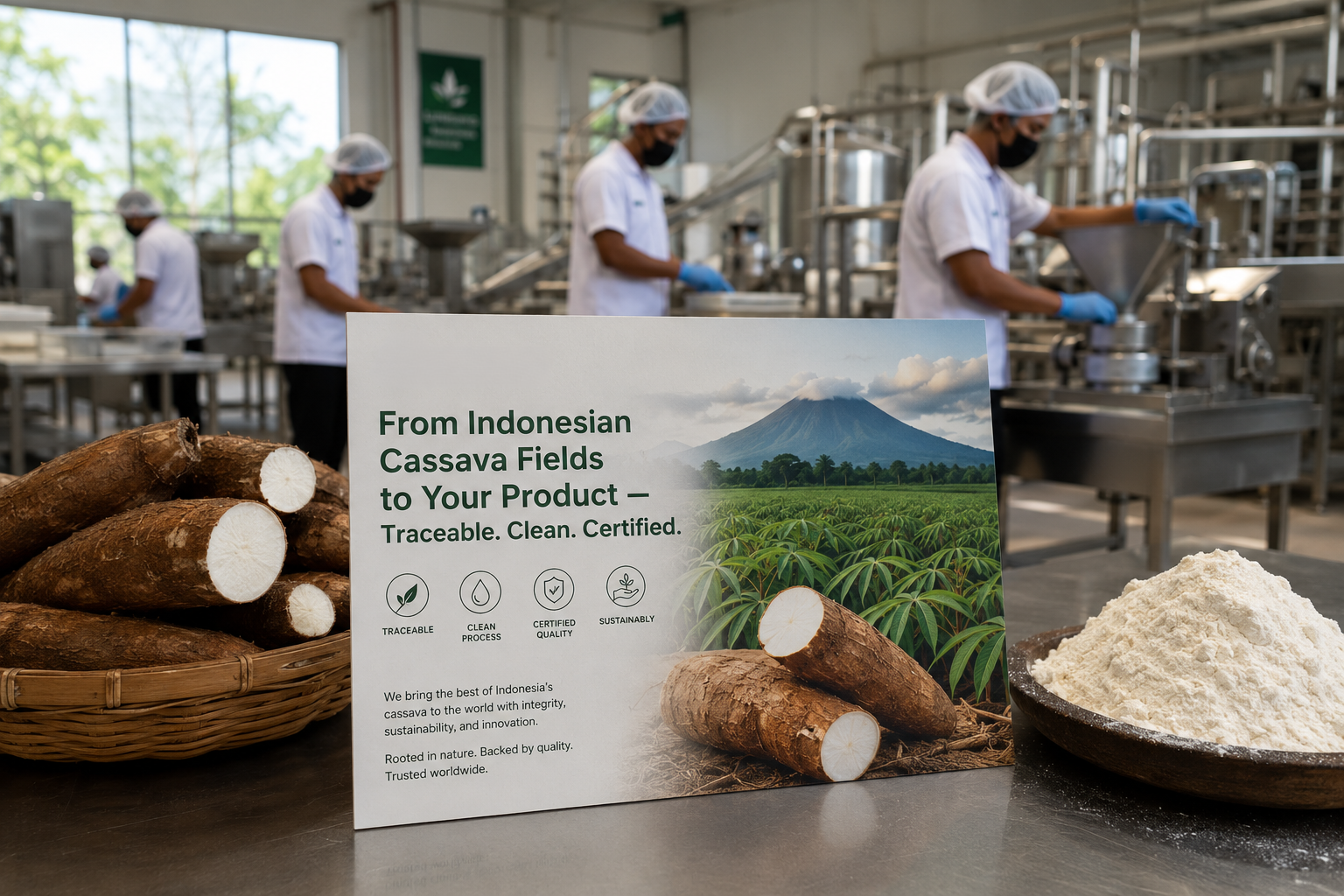
Supply chain storytelling increases product value by converting commodity inputs into verified, ethical, and high-performance assets. By highlighting transparent sourcing—such as sustainable Indonesian cassava or premium fiber cultivation—brands satisfy the “conscious consumer” mandate, defend against competitive discounting, and justify premium pricing on Amazon through verified trust signals.
Amazon’s search algorithm and retail category managers both prioritize products that can verify their claims. Consumers are increasingly sophisticated, using tools to cross-reference ingredient sources and ethical certifications. A brand that simply lists “Cassava Flour” on its label is a commodity; a brand that details its partnership with high-integrity, high-traceability suppliers is a partner in the consumer’s lifestyle.
When you pull back the curtain on your ingredient sourcing, you solve a primary consumer friction point: the fear of “hidden” additives. By showcasing your supply chain, you demonstrate:
Traceability: Identifying the origin of your native tapioca starch or pea protein.
Safety: Emphasizing the technical oversight and third-party audits (like FSSC 22000) that protect every batch.
Stability: Proving that your product consistency is a result of intentional, stable sourcing rather than spot-market fluctuations.
The digital shelf on Amazon is highly competitive. To move away from the “race to the bottom” in pricing, you must lean into high-value product page storytelling.
A+ Content Strategy: Use your Amazon A+ modules to map your ingredient journey. Include high-resolution visuals of the farming regions or the technical milling facilities. This visual proof justifies a higher price point by emphasizing the quality of the raw material.
Front-of-Pack Signaling: Use badges that highlight your supply chain (e.g., “Sourced from Sustainable Indonesian Roots”). This acts as a shortcut for the consumer’s decision-making process, separating your product from generic alternatives.
Retail Buyer Pitching: Category managers are constantly looking for brands that mitigate risk. Bringing a “supply chain audit trail” to your pitch shows that your brand is resilient, professional, and less likely to suffer from supply chain-related retail stockouts.
| Asset Type | Storytelling Angle | Marketing Benefit |
| Origin Story | Focus on the equatorial stability and freshness of the cassava root. | Establishes quality superiority over seasonal/volatile crops. |
| Technical Rigor | Explain the enzymatic hydrolysis behind your soluble fiber. | Positions your brand as a “science-backed” health authority. |
| Ethical Sourcing | Highlight the traceability from small-cluster farm to mill. | Appeals to socially conscious demographics and retail buyers. |
| Manufacturing | Detail the GFSI-certified safety protocols in production. | Builds “Trust Equity” and reduces consumer risk perception. |
The objective of ingredient storytelling is to change the conversation from price per unit to value per serving. When a consumer understands that your soluble tapioca fiber is derived from non-GMO, sustainably sourced, and highly processed roots, they perceive the product as “premium.”
This allows your brand to command a higher price point because you are no longer competing with bottom-tier generic brands. You are competing on the basis of safety, performance, and ethical sourcing.
Storytelling is only as effective as the integrity of the information provided. If your supply chain data is opaque, your marketing narrative will eventually be exposed as hollow.
Blue Highcrest provides a foundation of supply chain excellence that empowers your marketing team to tell an authentic, verifiable story. We offer:
Full Traceability: Detailed origin reports that map your starch and flour back to reliable, high-performance Indonesian production clusters.
Certified Quality: Third-party verified data that your marketing team can use to support claims about safety, non-GMO status, and gluten-free integrity.
Technical Proof: Detailed documentation (TDS, COA) that serves as the “source of truth” for your A+ content and marketing claims.
Don’t let your high-quality products be treated as commodities. Contact the supply chain strategy team at Blue Highcrest today to request our vendor transparency packs, origin visual assets, and technical documentation—the building blocks for your next premium product narrative.
[Partner with Blue Highcrest to Elevate Your Brand Story]
Use image-heavy modules that feature a “Seed-to-Shelf” timeline. Include specific icons for certifications, maps of the ingredient’s region of origin, and clear bullet points detailing the functional benefit of the raw material compared to traditional substitutes.
Yes. Studies consistently show that consumers prioritize “clean” and “transparent” labels over price when purchasing functional foods. By providing proof of your ingredient’s origin, you eliminate skepticism and convert the “conscious consumer” who researches before they buy.
Always base your marketing claims on the documentation provided by your supplier. Blue Highcrest provides verified Certificates of Analysis (COA) and compliance documentation that ensure your marketing team’s claims are legally and technically defensible.
Whether you name them directly or refer to the “region of origin” depends on your brand strategy. However, the most important element is to have the documentation available on your website or upon request, which builds professional trust with retail buyers who are performing due diligence on your company.