
For FMCG brand managers, marketing directors, and product innovators, adding a “High Fiber” or “Source of Fiber” claim to your packaging is a powerful commercial differentiator. Consumers are hyper-focused on digestive health, wellness, and satiety. Front-of-pack nutrient claims drive rapid purchasing decisions in retail aisles.
However, translating an optimized formulation into a legally compliant packaging claim is a rigorous regulatory process. Making a fiber claim involves navigating distinct, non-negotiable legal frameworks enforced by the US Food and Drug Administration (FDA) and the European Commission. Mistaking these requirements can result in costly product recalls, regulatory warning letters, and damaging class-action lawsuits.
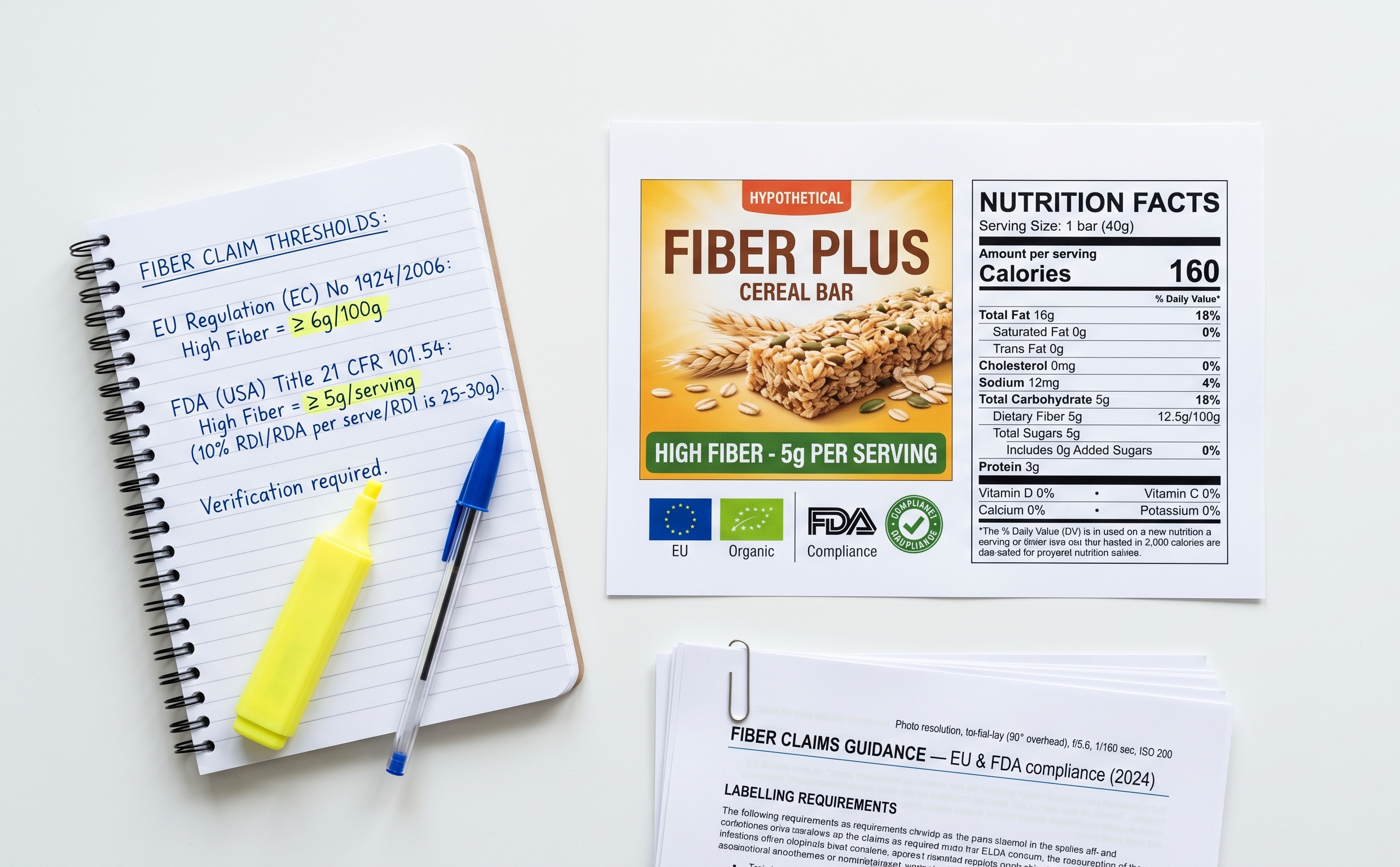
To legally claim “High Fiber” in the US, a product must contain at least 20% of the Daily Value (5.6g of FDA-approved fiber per RACC). In the EU, it must contain at least 6g of fiber per 100g or 3g per 100 kcal. Utilizing an approved ingredient like soluble tapioca fiber ensures cross-border compliance.
Historically, food brands inflated fiber metrics on nutrition panels by utilizing cheap, isolated carbohydrate chains. However, regulatory updates have fundamentally shifted the compliance landscape. Regulators now require explicit proof that an isolated fiber delivers validated, physiological health benefits—such as lowering blood glucose, improving calcium absorption, or aiding bowel function.
For instance, older generations of Isomalto-oligosaccharides (IMOs) were widely stripped of their dietary fiber status by the FDA because they behaved more like a sugar inside the human body. For a brand team, relying on unapproved or legally ambiguous ingredients creates a ticking clock of regulatory risk.
To future-proof your product pipeline against shifting regulatory definitions, your brand team must choose an ingredient that satisfies both functional performance and international legal standards. This is where soluble tapioca fiber has emerged as the premier industry solution.
Derived via the controlled enzymatic hydrolysis of native tapioca starch, soluble tapioca fiber is recognized as a legitimate, health-promoting dietary fiber across major international markets. It bypasses the regulatory hurdles associated with synthetic substitutes, allowing your brand team to claim true fiber enrichment while maintaining an exceptionally clean, non-GMO, plant-based ingredient deck.
In the United States, nutrient content claims are governed strictly under 21 CFR Part 101. To legally market a fiber-related benefit on your packaging, you must calculate your formulations against the Reference Amounts Customarily Consumed (RACC) for your specific food category.
“Good Source of Fiber” Claim: The product must contain 10% to 19% of the Daily Value (DV) per reference amount. Based on the current standard DV of 28g for adults, this equates to 2.8g to 5.3g of fiber per serving.
“High Fiber” or “Excellent Source of Fiber” Claim: The product must contain 20% or more of the Daily Value per reference amount, which translates to a minimum of 5.6g of approved dietary fiber per serving.
Furthermore, the FDA mandates that the ingredient used must be listed on their approved registry of isolated or synthetic dietary fibers. Soluble tapioca fiber successfully fulfills these stringent criteria, allowing your brand to secure front-of-pack compliance safely.
The European Union operates under a completely different, metrics-driven approach established by Regulation (EC) No 1924/2006 on Nutrition and Health Claims. Unlike the US system, which ties claims to arbitrary portion sizes (RACC), the EU standardizes claims against product weight or caloric delivery.
“Source of Fibre” Claim: The final food product must contain at least 3g of fibre per 100g, or at least 1.5g of fibre per 100 kcal.
“High Fibre” Claim: The product must contain at least 6g of fibre per 100g, or at least 3g of fibre per 100 kcal.
If your brand is engineering an extruded snack, a meal replacement beverage, or a functional bakery item for the European retail market, your formulation must maintain these exact mathematical ratios throughout its shelf life.
| Regulatory Region | “Source of / Good Source” Minimum Requirement | “High Fiber / High Fibre” Minimum Requirement | Calculation Metric Base |
| United States (FDA) | 2.8g per serving | 5.6g per serving | Based on 28g DV per category RACC |
| European Union (EU) | 3g per 100g OR 1.5g per 100 kcal | 6g per 100g OR 3g per 100 kcal | Fixed weight or energy metric ratio |
Executing a successful product launch requires absolute alignment between your brand marketing vision and your R&D department’s formulation constraints. Marketing teams often demand a “High Fiber” claim late in the development cycle without realizing that changing fiber types can destabilize a food matrix.
Swapping a commodity corn fiber or a gritty inulin for premium soluble tapioca fiber preserves the product’s flavor profile and moisture retention. This synergy ensures that the product your marketing team promotes on-pack is identical to the premium sensory experience the consumer enjoys at home.
Navigating cross-border compliance demands a sophisticated ingredient partner who understands both food science and regulatory law. Blue Highcrest provides premium, non-GMO soluble tapioca fiber engineered to satisfy the exact regulatory benchmarks of both the US FDA and EU markets.
Our high-purity soluble tapioca fiber offers excellent structural stability, high solubility, and a clean, neutral taste profile that blends seamlessly into bar matrices, powdered beverages, and functional baked goods. When you partner with Blue Highcrest, you aren’t just buying a bulk texturizer—you are securing the certified technical data, rigorous traceability, and legal peace of mind required to take your brand to market confidently.
Don’t let regulatory compliance delays derail your next major retail launch. Contact the strategy and compliance team at Blue Highcrest today to request technical data sheets, compliance certifications, and product samples of our premium Soluble Tapioca Fiber.
Yes, but only if the isolated fiber source is explicitly approved by the relevant governing regulatory body (such as the FDA in the US or EFSA in the EU) as demonstrating a validated physiological health benefit to humans.
Making an unverified or non-compliant nutrient content claim can result in severe enforcement actions, including FDA warning letters, mandatory retail product recalls, customs seizures during export, and costly private class-action lawsuits for deceptive labeling.
Yes. Our premium soluble tapioca fiber is manufactured under strict quality standards to ensure it meets the legal definitions and scientific criteria required to support “Source of Fiber” and “High Fiber” claims in both jurisdictions.
Because the US FDA bases claims on the Reference Amount Customarily Consumed (RACC), a small-portion snack (like a 40g bar) must still pack a concentrated 5.6g of fiber to legally carry a “High Fiber” claim, making high-purity syrups like those from Blue Highcrest essential.