
For food scientists, research and development managers, and procurement officers in the plant-based space, navigating ingredient specifications is a balance between nutritional targets and cost-in-use metrics. As global demand for allergen-free, clean-label proteins accelerates, pea protein has established itself as the leading alternative to soy and dairy.
However, when finalizing a formulation, you face a critical specification choice: Pea Protein Isolate (PPI) versus Pea Protein Concentrate (PPC). Selecting the wrong grade can compromise your product’s flavor profile, destabilize its emulsion matrix, or inflate your manufacturing costs.
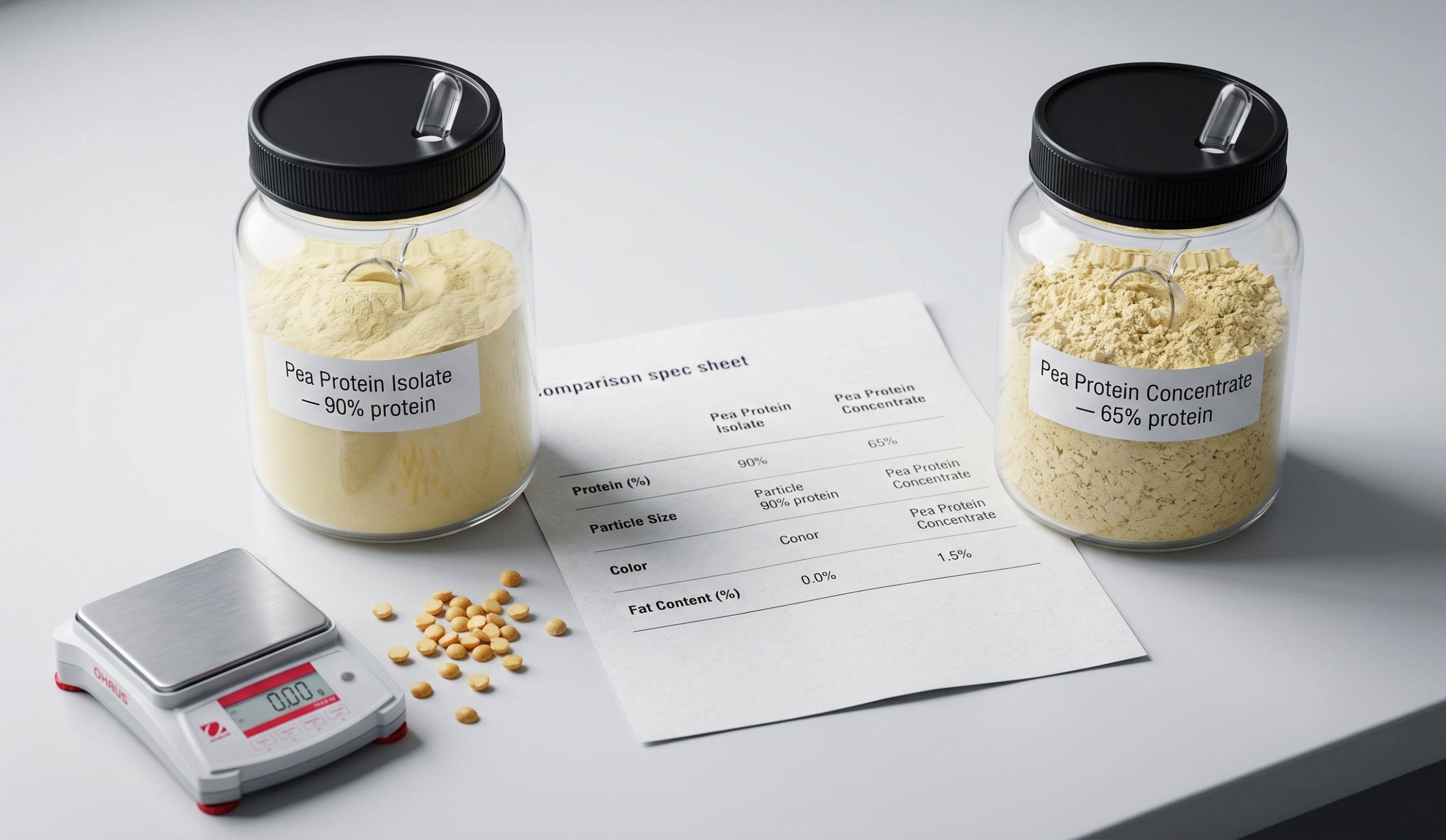
The primary difference lies in protein density and processing: Pea Protein Isolate undergoes advanced purification to achieve a minimum 80% to 85% protein content on a dry basis, removing most fats, fibers, and oligosaccharides. Pea Protein Concentrate retains more of the native plant matrix, yielding a 50% to 65% protein content.
Choosing between an isolate and a concentrate involves evaluating how the non-protein components—specifically remaining lipids and carbohydrates—interact within your food matrix.
If your brand is targeting a front-of-pack “High Protein” claim on a low-carbohydrate beverage or a sports nutrition powder, Pea Protein Isolate is the industry standard. Because it delivers a highly concentrated dose of protein per gram of raw ingredient, you can meet strict nutritional thresholds without bloating your serving size or total caloric load.
The mechanical concentration process used to produce PPC leaves behind native volatile organic compounds (hexanal) and lipids. These components are responsible for the characteristically strong, earthy, “beany” notes associated with raw peas.
Conversely, the wet extraction and washing phases used to manufacture Pea Protein Isolate strip away these compounds. This yields a much cleaner, neutral sensory profile, significantly reducing the need for expensive flavor-masking agents in delicate applications like dairy alternatives or meal replacement shakes.
Isolates exhibit superior solubility and functionality due to the removal of insoluble fibers.
Emulsification: Isolates readily form stable oil-in-water emulsions, making them ideal for plant-based milks and creamers.
Water Binding: The high protein density provides exceptional water-binding capacity, creating the essential fibrous, meat-like textures required in high-moisture meat analogues (HME) and extruded meat alternatives.
At first glance, Pea Protein Concentrate appears to be the more economical choice due to its lower raw material price per kilogram. However, an experienced procurement manager must calculate the true cost-in-use rather than the initial purchase price.
Because concentrate delivers a lower percentage of pure protein, you must add significantly more raw powder to achieve the same nutritional targets on your label.
The Formulation Math: If your target is 20 grams of protein per serving, you would require approximately 24 grams of an 83% Isolate. Achieving that same 20-gram target with a 60% Concentrate requires 33.3 grams of powder—increasing your total formula weight, thickening your product’s viscosity uncontrollably, and expanding packaging dimension requirements.
| Technical Attribute | Pea Protein Isolate (PPI) | Pea Protein Concentrate (PPC) |
| Protein Content (Dry Basis) | 80% to 85%+ | 50% to 65% |
| Fat & Fiber Content | Minimal (< 3% fiber, low lipid profile) | Higher (retains native pea fibers and fats) |
| Flavor Profile | Clean, neutral; low masking required | Earthy, distinct legume/beany notes |
| Key Applications | RTD beverages, infant nutrition, meat analogues | Baked goods, pet food, affordable snacks |
| Cost Dynamics | Premium per kilo; highly efficient cost-in-use | Lower per kilo; requires higher dosage volume |
Ready-to-Drink (RTD) Beverages & Protein Powders: Where low viscosity, smooth mouthfeel, high solubility, and neutral taste are paramount.
Plant-Based Dairy (Milks, Yogurts, Cheeses): Requires high emulsification stability to prevent phase separation and grittiness over shelf life.
Advanced Meat Alternatives: Essential for high-shear extrusion processes to mimic the structural bite of animal muscle fibers.
Nutritional Bakery & Snacks: Where the native fiber content aids dough structure and the earthy flavor can be masked by cocoa, grains, or spices.
Premium Pet Nutrition: Excellent for grain-free kibble and treats looking to bolster protein metrics cost-effectively.
When your product’s success rests on a reliable ingredient specification, Blue Highcrest delivers the technical precision your R&D team demands. We supply a premium, non-GMO Pea Protein Isolate meticulously processed to guarantee a minimum 80% protein content with an exceptionally low flavor profile.
Our isolate is engineered for superior dispersibility and stability, ensuring your liquids stay perfectly suspended and your solids maintain their structural integrity. By partnering with Blue Highcrest, you secure a transparent, fully traceable supply chain that complies with the rigid safety regulations of both the US and EU markets.
Stop compromising on taste and solubility. Contact the technical applications team at Blue Highcrest today to discuss your project requirements, access comprehensive technical data sheets, and order a functional sample kit of our premium Pea Protein Isolate.
No. Pea protein isolate is naturally hypoallergenic, gluten-free, and soy-free. It is an ideal plant-based protein source for clean-label brands targeting consumers with dietary restrictions or sensitivities.
Upon heating during the manufacturing process, the proteins in the isolate unfold and cross-link, creating a three-dimensional gel network. This matrix locks in moisture and fats, replicating the juicy, firm bite of traditional animal proteins.
Because concentrate undergoes less intensive filtration, it retains native lipids and enzymes. These fats can undergo minor oxidation, creating volatile compounds that impart a characteristic “beany” flavor to the finished food product.
Yes. Depending on your specific application—whether you need an ultra-fine mesh for smooth RTD powdered beverages or a standard grade for texturized extrusion—Blue Highcrest can provide the exact particle size distribution your machinery requires.