
Whole-root cassava flour is a rich, natural source of Type 2 Resistant Starch (RS2), offering prebiotic gut health benefits, improved insulin sensitivity, and short-chain fatty acid (SCFA) production. Unlocking this overlooked functional benefit allows food technologists and brand managers to position gluten-free baked goods and snacks as premium gut-health solutions without modifying clean-label ingredient decks.
In the competitive landscape of functional food innovation, brand differentiation often depends on highlighting hidden nutritional value. While cassava flour is widely recognized for its clean-label binding, neutral taste, and allergen-free wheat replacement capabilities, its high concentration of native resistant starch remains largely underutilized in product marketing and packaging strategies.
By understanding the physiological mechanics of resistant starch and optimizing processing parameters to preserve its integrity, brand teams can capture high-value consumer segments seeking digestive wellness, low-glycemic satiety, and metabolic health.
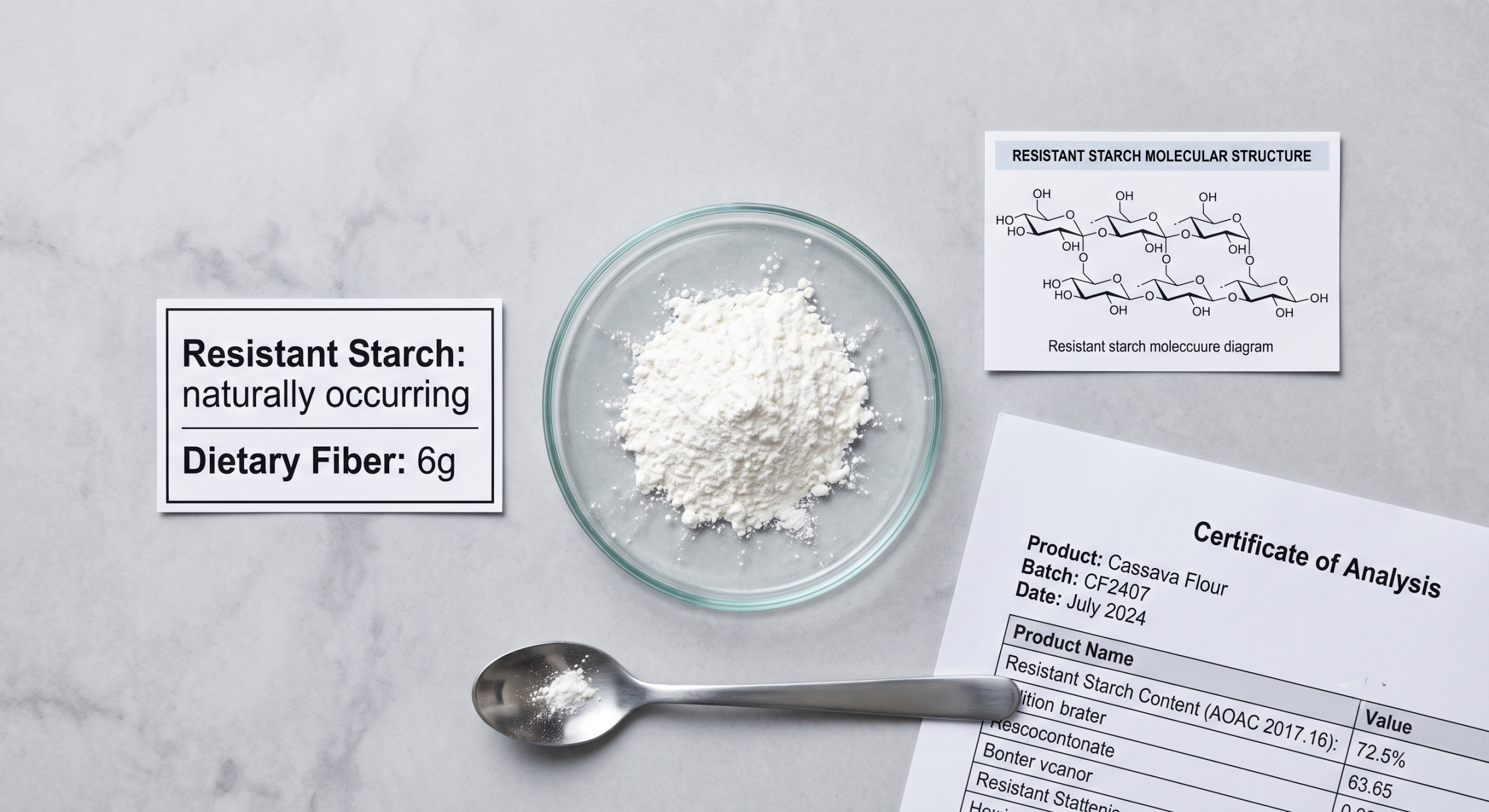
Resistant starch is a unique fraction of dietary carbohydrate that resists enzymatic digestion in the human small intestine. Instead of breaking down into glucose, it passes into the large intestine, where it functions as a high-performance prebiotic fiber.
RS1: Physically inaccessible starch trapped within intact plant cell walls (e.g., whole grains, legumes).
RS2: Native, ungelatinized crystalline starch granules that naturally resist enzymatic cleavage (e.g., raw green bananas, high-amylose maize, premium whole-root cassava flour).
RS3: Retrograded starch formed when gelatinized starches are cooked and subsequently cooled (e.g., chilled cooked potatoes or processed cassava snacks).
RS4: Chemically modified starches engineered for industrial resistance.
Whole-root cassava flour naturally contains significant levels of native RS2. When processed correctly, a portion converts into RS3, giving R&D teams a dual-action resistant starch profile that supports digestive wellness.
When resistant starch reaches the colon, beneficial gut microbiota (such as Bifidobacteria and Faecalibacterium prausnitzii) ferment the carbohydrate matrix into short-chain fatty acids (SCFAs), primarily butyrate, acetate, and propionate.
[ Cassava Flour RS2/RS3 ]
          │
          ▼ (Bypasses Small Intestine)
┌─────────────────────────────────────────┐
│     Colonic Microbial Fermentation      │
└─────────────────────────────────────────┘
          │
          ▼
┌─────────────────────────────────────────┐
│  Short-Chain Fatty Acids (SCFAs)        │
│  • Butyrate (Sustains Colon Lining)     │
│  • Acetate & Propionate (Metabolism)    │
└─────────────────────────────────────────┘
          │
          ▼
┌─────────────────────────────────────────┐
│   Functional Consumer Benefits          │
│   • Satiety & Slower Glucose Release    │
│   • Prebiotic Microbiome Support        │
│   • Low-FODMAP Digestive Comfort        │
└─────────────────────────────────────────┘
This fermentation process yields significant physiological benefits that can back on-pack functional claims:
Satiety and Blood Sugar Control: Resistant starch slows the rate of gastric emptying and blunts postprandial blood glucose spikes, making it an ideal ingredient for low-glycemic or keto-friendly formulations.
Low-FODMAP Friendly: Unlike fast-fermenting soluble fibers like inulin, resistant starch ferments gradually along the length of the colon, minimizing gas, cramping, and bloating. This makes cassava flour a core asset for Low-FODMAP product development strategies.
Colon Wall Integrity: Butyrate serves as the primary energy source for colonocytes, strengthening the gut barrier and lowering systemic inflammation markers.
A common technical bottleneck for food scientists is preserving resistant starch levels through thermal processing, such as baking, extrusion, or retorting. Heat and moisture trigger starch gelatinization, which unravels the crystalline RS2 structure into rapidly digestible starches.
To protect resistant starch yield and maximize on-pack claims, R&D teams can implement specific thermal and formulation controls:
| Processing Stage | Impact on Resistant Starch | Technical Optimization Strategy |
| Mixing & Hydration | Low gelatinization risk | Maintain cool water temperatures (<30°C) during initial dough blending. |
| Baking / Extrusion | High RS2 loss (Gelatinization) | Utilize high-temperature, short-time (HTST) profiles to limit prolonged moisture exposure. |
| Post-Bake Cooling | RS3 Formation (Retrogradation) | Implement controlled chilling (4°C–8°C for 12–24 hours) post-bake to induce amylose crystallization. |
| Extruded Puffing | High shear breaks starch bonds | Combine cassava flour with native high-amylose starches to buffer structural integrity. |
By incorporating a post-bake cooling step (retrogradation), formulators convert amorphous gelatinized starch into stable RS3, successfully reclaiming dietary fiber values on final analytical panels.
Integrating resistant starch into your product story bridges the gap between technical food science and commercial growth. Expanding your functional claim portfolio directly drives top-line growth, as detailed in our guide on the Revenue Case for Soluble and Dietary Fiber Product Lines.
“Powered by Prebiotic Resistant Starch”
“Gentle on the Gut / Low-FODMAP Friendly Base”
“Sustained Energy & Slow-Release Carbs”
“Gut-Health Friendly Clean-Label Baking”
Because cassava flour is a recognized whole food ingredient, brands can promote these functional wellness claims on packaging without dirtying the ingredient deck with synthetic additives or isolated fiber extract codes.
Unlocking consistent resistant starch yields requires raw cassava flour produced under strict agricultural and thermal controls. Blue Highcrest provides premium, whole-root cassava flour processed to preserve native starch structures and ensure batch-to-batch analytical predictability.
Our high-grade cassava flour delivers:
High Native Amylose Profiles: Optimizing retrograded RS3 yield during post-baking cooling cycles.
Low Moisture Volatility: Standardized moisture baselines (<12%) to prevent pre-gelatinization during transit and storage.
Clean Sensory & Color Consistency: Pure white appearance and neutral taste that preserve the delicate flavor profiles of functional snacks and baked goods.
Don’t leave valuable functional claims on the table. Partner with Blue Highcrest to access premium cassava flour engineered to satisfy the rigorous technical, nutritional, and marketing demands of global food brands.
Ready to quantify the resistant starch potential in your next development sprint? Contact our technical sales team at Blue Highcrest to request a commercial sample kit, complete Certificates of Analysis (COA), and resistant starch testing protocols.
Under FDA and EU guidelines, resistant starch that functions physiologically as an indigestible carbohydrate can be measured via AOAC analytical methods (such as AOAC 2002.02 or 2011.25) and included in the total dietary fiber value on the nutrition panel.
Baking converts native RS2 into gelatinized starch. However, as the baked product cools, the amylose polymers recrystallize into RS3 (retrograded starch), recovering a significant portion of the original resistant starch content.
Whole-root cassava flour contains higher native resistant starch, dietary fiber, and plant polymers than isolated tapioca starch. Tapioca starch consists almost entirely of pure, fast-gelatinizing starches that offer minimal native RS2 content.
Yes. Resistant starch ferments slowly in the large intestine without producing rapid gas spikes, making it highly tolerable and well-suited for Low-FODMAP and sensitive-digestion product formulations.