
If your R&D team is evaluating dietary fibers for a new product launch, you have likely narrowed the field to two leading options: soluble corn fiber and soluble tapioca fiber. Both ingredients are classified as resistant dextrins. They are water-soluble, exhibit low-viscosity, and can successfully boost a fiber claim on your nutrition panel without destabilizing your existing formula.
However, they are not interchangeable. The differences between them—in processing origin, clean-label perception, digestive tolerance ceilings, and supply chain stability—are operationally significant for food manufacturers working at scale. This comparative guide breaks down exactly where each ingredient performs, where each creates risk, and which applications favor which choice.
When evaluating soluble corn fiber vs soluble tapioca fiber formulation paths, the main differentiator is raw material origin. Soluble corn fiber (derived from corn) carries potential GMO associations and a mild humectant effect. Soluble tapioca fiber (derived from cassava root) is naturally non-GMO, offers a cleaner sensory profile in liquids, and delivers a higher consumer digestive tolerance threshold.
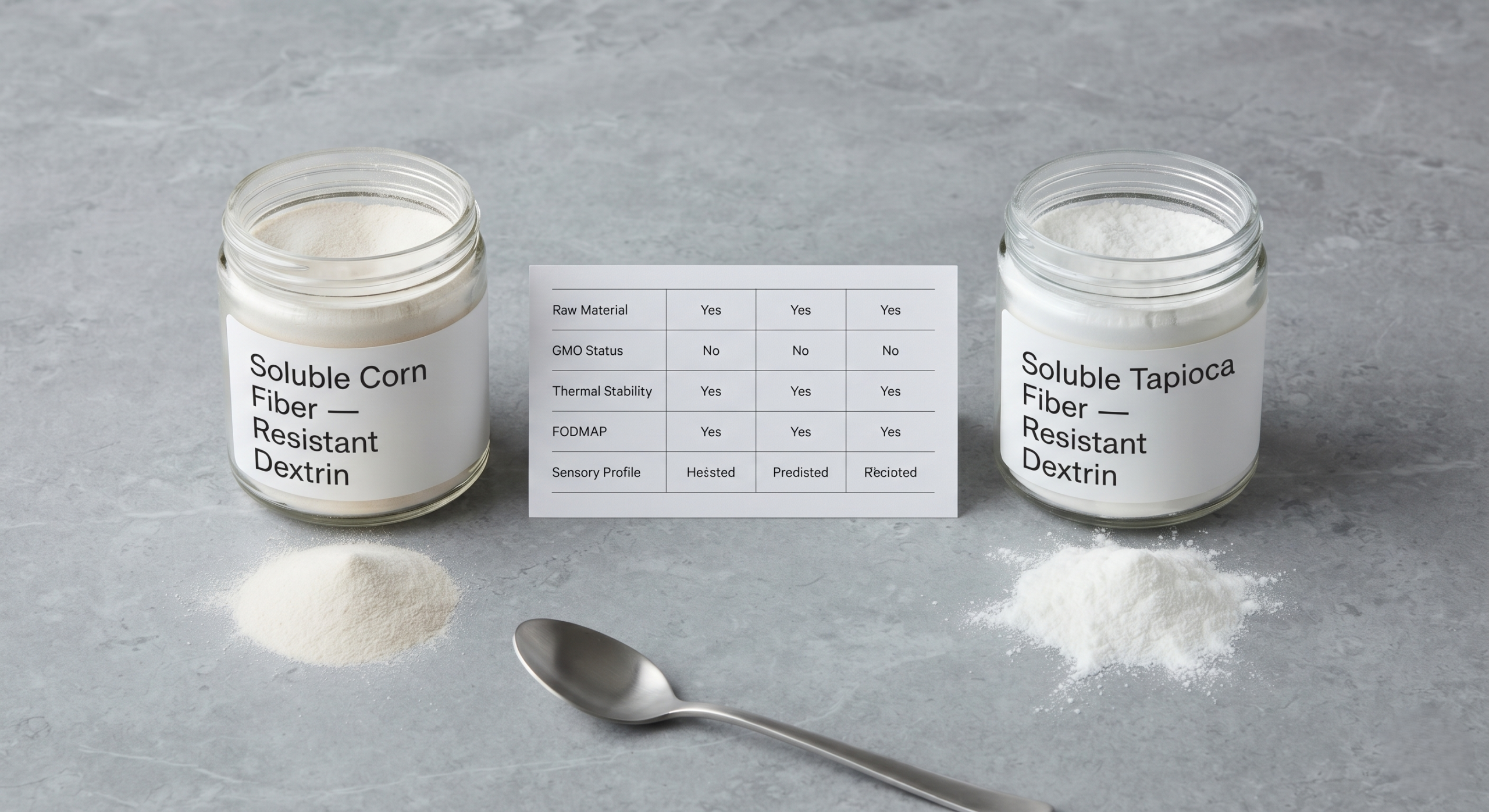
Both ingredients belong to the same functional category: resistant dextrins (or resistant maltodextrins). They are produced through a tightly controlled enzymatic and thermal process that rearranges the molecular bonds of a native starch.
This process breaks down the starch into shorter, highly branched chains that human pancreatic amylase cannot split. As a result, they resist digestion in the small intestine and travel to the colon, where they ferment slowly to deliver validated prebiotic fiber benefits.
The critical point of divergence is the source material:
Soluble Corn Fiber (SCF): Formulated from industrial corn starch.
Soluble Tapioca Fiber (STF): Extracted from cassava root starch.
Both dietary fibers have achieved full regulatory recognition across major global markets. The FDA recognizes resistant maltodextrin as a dietary fiber for nutritional panels, and both ingredients carry GRAS (Generally Recognized as Safe) status in the United States. In the EU and UK, both legally contribute to the dietary fiber content declared under Regulation (EU) No 1169/2011.
Where the clean-label calculus changes is in consumer perception and brand positioning.
Corn carries a non-trivial genetically modified (GMO) association in several consumer segments. Sourcing identity-preserved, non-GMO soluble corn fiber is possible, but it adds an extra verification step and audit trail to your supplier qualification workflow.
Conversely, cassava is naturally non-GMO. There are no commercially approved genetically modified cassava varieties in global agricultural production. Sourcing soluble tapioca fiber from reputable Southeast Asian producers provides your brand with an inherent non-GMO status, simplifying your clean-label documentation.
Choosing between these two fibers requires an understanding of how their subtle physical differences manifest on the factory floor.
Both fibers are significantly more heat-stable than inulin or fructooligosaccharides (FOS). Soluble tapioca fiber maintains a documented thermal stability window up to 250°C across a wide pH range of 2 to 7. This covers almost every aggressive manufacturing process, including UHT treatment, retort processing, spray drying, commercial baking, and extrusion. Soluble corn fiber performs comparably in this category, showing an identical thermal tolerance zone of 200–250°C.
Both fibers are classified as low-FODMAP, which is a major advantage over chicory root derivatives. Neither produces the rapid colonic fermentation that causes immediate gas, bloating, and distress at high inclusion rates.
However, population-level tolerance data suggests that soluble corn fiber may produce slightly higher gas volumes at high daily doses (above 25g/day) in sensitive individuals. Soluble tapioca fiber tends to be better tolerated across a broader dose range. For manufacturers targeting aggressive “High Fiber” positioning (e.g., 8g to 12g of fiber per serving), this tolerance ceiling is critical to minimizing consumer complaint rates.
Both fibers dissolve readily in water at room temperature to form low-viscosity, crystal-clear solutions. However, in direct sensory panels, soluble tapioca fiber tests as slightly cleaner. It is entirely flavor-neutral, making it the ideal fit for transparent liquids and clear protein drinks where any off-note or residual sweetness is easily detected. Soluble corn fiber can contribute a faint, natural sweetness; this can be helpful in low-sugar applications but problematic in savory or neutral-flavor formulations.
Protein and Nutrition Bars: Both fibers function excellently as binders. Soluble tapioca fiber is preferred for brands targeting low-FODMAP, sensitive-gut, or premium health positioning. Soluble corn fiber’s mild humectant effect can be leveraged if your formulation requires extending a softer bar texture over a 12-month shelf life.
Ready-to-Drink (RTD) Beverages: Soluble tapioca fiber is the stronger choice for clear liquid systems. Its absolute sensory neutrality preserves delicate flavor profiles without clouding the beverage.
Baked Goods: Soluble corn fiber’s moisture-retention properties make it well-suited for soft-baked items like breads, soft cookies, and muffins. Soluble tapioca fiber works equally well where a crisper finish or a strictly neutral texture profile is required.
Keto and Low-Carb Products: Both fibers are fully compliant for net carbohydrate subtraction in relevant markets. Soluble tapioca fiber’s clean, corn-free positioning aligns naturally with premium keto brand standards.
Once your R&D team validates that both fibers meet your technical criteria, the procurement decision comes down to supply chain stability.
| Commercial Factor | Soluble Corn Fiber (SCF) | Soluble Tapioca Fiber (STF) | Procurement Impact |
| Supply Concentration | North America, China | Southeast Asia (Indonesia, Thailand) | STF avoids tariff complications common to Chinese imports |
| Input Price Volatility | High (Tied to energy & ethanol) | Low / Relatively Stable | STF allows for more predictable 12-month cost modeling |
| Halal Verification | May require process audits | Straightforward compliance paths | Indonesian STF aligns smoothly with global halal standards |
Corn is a heavily traded global commodity whose price fluctuates rapidly based on global energy markets, biofuel mandates, and weather events in the US Midwest. Cassava is cultivated year-round in tropical climates with far less exposure to speculative commodity markets, offering historically stable input costs. Procurement managers looking to shield their margins from inflation benefit from the lower price variability of tapioca-derived ingredients.
At Blue Highcrest, we eliminate procurement and regulatory friction by providing clean-label, high-purity ingredient solutions for modern food manufacturing. We specialize in the high-volume supply of premium Soluble Tapioca Fiber syrup and powder, meticulously processed to meet the absolute strictest technical and regulatory data sheets.
Our wholesale distribution network guarantees:
Certified 90%+ Dietary Fiber Content: Ensuring your R&D calculations reliably match your front-of-pack nutrition claims.
Flawless Documentation Packages: Every container ship arrives with complete lot-specific Certificates of Analysis (COA), phytosanitary certificates, non-GMO declarations, and internationally recognized Halal compliance.
Consistent Batch Performance: Strict monitoring of molecular weight distribution ensures identical viscosity, solubility, and binding power across every single delivery run.
Optimizing your product line requires sourcing functional ingredients that protect your production margins while satisfying consumer demands for clean, allergen-free ingredients. Transitioning your formulations to a premium, non-GMO soluble tapioca fiber matrix allows your company to secure market compliance, reduce customer friction, and deliver a superior sensory experience.
Ready to evaluate premium soluble tapioca fiber in your lab? Contact Blue Highcrest today to connect with our technical ingredient experts, request industrial samples for bench-top testing, and lock in competitive wholesale contract rates for your upcoming manufacturing cycles.
In the vast majority of food applications, yes. Because both are low-viscosity, water-soluble resistant dextrins, they behave very similarly in manufacturing systems. We recommend running brief bench trials to verify texture and moisture dynamics in soft baked goods, where minor structural variances may occur.
To satisfy the regulatory requirements of the FDA, EFSA, and FSANZ, the dietary fiber content should be quantified using the AOAC 2009.01 or AOAC 2011.25 multi-enzyme analytical testing methods.
Inclusion rates vary depending on your target nutritional claim. In protein bars, inclusion typically ranges between 8% and 18% of total formula weight to confidently deliver a “High Fiber” or “Excellent Source of Fiber” front-of-pack claim.