
Tapioca starch from Indonesia maintains a more resilient, stable price floor than corn or potato starch due to non-globalized crop insulation, year-round harvest cycles, and decoupled bio-fuel market dynamics. For corporate procurement managers and brand owners, sourcing Indonesian tapioca provides a structural hedge against extreme raw material volatility and margin erosion.
In global food manufacturing, raw material price predictability is just as critical as technical performance. When ingredient costs fluctuate wildly, industrial manufacturers face immediate margin compression, unstable wholesale pricing, and severe inventory forecasting bottlenecks. While commodity starches like corn (maize) and potato are exposed to intense geopolitical, biofuel, and climate-driven price shocks, tapioca starch harvested in equatorial regions presents a fundamentally different economic model.
Understanding the structural mechanics behind Indonesia’s stable tapioca pricing allows food brands to de-risk their supply chains while advancing their clean-label ingredients retail strategy.
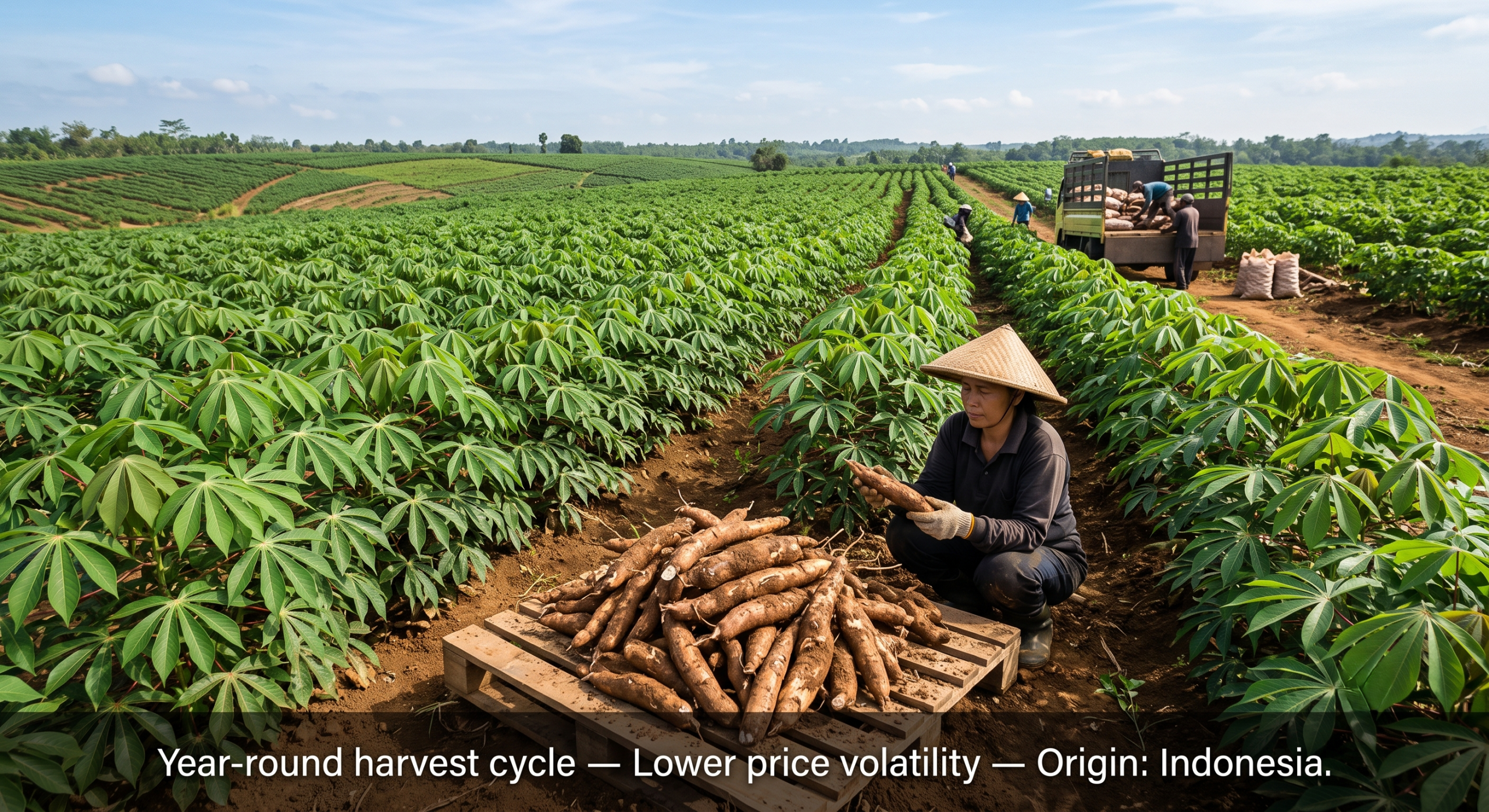
The primary driver of price spikes in the global starch market is the intersection of multi-use crop demand and seasonal harvest vulnerabilities. Corn and potato starches are deeply entangled in these macroeconomic vulnerabilities, whereas Indonesian tapioca is naturally insulated.
Corn is heavily globalized and multi-channeled; a supply shock in the global ethanol sector or an increase in livestock feed demand instantly drives up the cost-per-ton of corn starch. Cassava (the root source of tapioca starch), however, is primarily processed directly into food-grade and industrial starches. Its pricing is dictated by actual starch supply and demand rather than international energy mandates.
Potato starch production is highly dependent on rigid, single-window seasonal harvests in temperate zones, making its global price floor incredibly sensitive to localized frost or drought. In contrast, Indonesia’s equatorial climate allows for staggered, year-round planting and harvesting of cassava roots. This constant supply eliminates the dramatic “pre-harvest speculation” price curves typical of Western European potato crops.
When building a multi-year procurement matrix, calculating the true cost-in-use requires accounting for price volatility variables over a 24-month horizon.
| Starch Type | Primary Price Drivers | Global Market Correlation | Volatility Risk Index |
| Indonesian Tapioca Starch | Regional agricultural output, local milling capacity | Low (Insulated from global grain markets) | Low / Predictable |
| Corn Starch | Global ethanol mandates, livestock feed demand, oil prices | High (Tied to Chicago Board of Trade futures) | High / Speculative |
| Potato Starch | Northern European weather events, fertilizer energy costs | Moderate to High (Highly seasonal) | Extreme / Variable |
By embedding tapioca starch into your formulations, your R&D and finance teams build a predictable baseline. The ingredient avoids the unexpected 30–50% cost spikes that frequently hit corn and wheat derivatives during geopolitical or energy crises. To maximize this financial stability, procurement teams must know how to effectively evaluate a tapioca starch supplier’s long-term contract reliability.
Beyond raw agricultural mechanics, the logistical landscape of Southeast Asian trade routes further solidifies the cost efficiency of Indonesian sourcing.
Indonesia operates within major international trade frameworks that offer reduced tariff structures and streamlined customs clearance into key manufacturing hubs across Europe, the Americas, and APAC markets. Unlike European potato starch, which frequently faces complex regulatory cross-winds and fluctuating import duties, or heavily subsidized corn crops subject to retaliatory anti-dumping tariffs, Indonesian tapioca flows along highly predictable, established trade lanes.
Securing a direct partner with localized milling assets allows brand owners to lock in fixed-freight and fixed-price contracts, mitigating container shipping premiums.
Mitigating pricing volatility requires an ingredient partner with deep localized infrastructure and structural risk management. Blue Highcrest provides premium, industrial-grade tapioca starch sourced directly through fully verified supply chains in Indonesia.
We de-risk your procurement strategy through:
Direct Mill Integration: By removing multi-tiered commodity brokers, we stabilize your pricing and guarantee direct-from-source economics.
Rigorous Quality Standardization: Our native tapioca starch is processed to maintain a pure white profile, neutral taste, and excellent viscosity stability, matching your exact technical parameters batch after batch.
Predictable Contract Mapping: We offer flexible, forward-contracting options that shield your brand from sudden macro-economic shifts.
For an operational blueprint on managing this asset efficiently, read our comprehensive Tapioca Starch Sourcing Indonesia Procurement Guide.
To successfully transition your product portfolio away from volatile grain starches:
Audit Your Viscosity Curve: Work with your R&D team to map how native tapioca starch can replace corn starch without altering final textures.
Request Long-Term Forward Contracts: Move away from spot-market buying and secure 12-to-24-month volume commitments to lock in price floors.
Diversify Regional Origin: Blend your starch registry to favor equatorial crops, ensuring consistent container flow regardless of shifting grain markets.
Don’t let unpredictable grain and potato market spikes compromise your product’s profitability or retail positioning. Blue Highcrest delivers premium, clean-label Indonesian tapioca starch tailored to meet the strict commercial, regulatory, and financial benchmarks of global brands.
Ready to optimize your raw material budget? Reach out to our international trade desk at Blue Highcrest to request a 5kg pilot-scale sample kit, complete Certificates of Analysis (COA), and tailored contract terms for your volume requirements.
Indonesian cassava is primarily cultivated by localized network farms specialized in food starch processing. Because it is not traded on global speculative grain exchanges like the Chicago Board of Trade (CBOT) and is not utilized for industrial livestock feed or mass biofuel production, its pricing remains anchored to steady, local production realities.
Yes. Tapioca starch actually features a lower gelatinization temperature than corn starch and provides superior clarity and freeze-thaw stability. R&D teams can often drop tapioca starch directly into sauces, snacks, and bakery matrices with minor adjustments to moisture and shear parameters.
Because Indonesia lacks a harsh winter freeze, cassava roots mature and are harvested continuously across different provinces every month. This constant flow eliminates the acute supply bottlenecks, seasonal warehousing surcharges, and post-harvest price spikes common to European and North American crops.
Every container of tapioca starch supplied by Blue Highcrest is backed by a comprehensive QA package, including complete microbiological analysis, heavy metal screening, non-GMO declarations, and phytosanitary certifications tailored for seamless US FDA and European Union customs entry.