
Integrating soluble corn fiber into keto chocolate formulations successfully lowers net carb counts while preserving the characteristic snap, glossy temper, and smooth melt-down of traditional sugar-sweetened chocolate. By replacing sugar bulking mass with a low-glycemic, high-purity dietary fiber, food technologists can avoid the bloom, cooling sensation, and digestive distress associated with high-polyol sugar substitutes.
For R&D teams and brand managers, low-carb and keto-friendly chocolate is one of the highest-margin categories in functional confectionery. However, removing sucrose from chocolate formulas introduces severe structural and sensory bottlenecks. Sucrose does not merely provide sweetness; it contributes over 40% to 50% of the solid bulk required for proper cocoa butter crystallization, temper retention, and viscosity control during conching.
Understanding the rheological behavior of soluble corn fiber allows formulators to create a low-net-carb, clean-label chocolate product that satisfies strict keto macros while delivering a premium confectionery experience.
Soluble corn fiber replaces sucrose by acting as a non-crystallizing, high-fiber bulking agent (delivering 85%+ dietary fiber on a dry basis) with low hygroscopicity and high thermal stability. Because human digestive enzymes cannot break down its complex glycosidic bonds, its carbohydrate mass is deducted from total carbohydrates, significantly lowering “Net Carbs.” Functionally, it maintains proper fat-to-solids ratios during conching, preventing fat bloom while preserving temper, clean snap, and a velvety mouthfeel.
When formulators rely solely on sugar alcohols (such as erythritol, maltitol, or xylitol) to replace sucrose in chocolate, they frequently encounter technical and sensory defects:
Cooling Sensation & Recrystallization: Polyols like erythritol feature a negative heat of solution, creating an intense “cooling” effect that masks chocolate notes. Their high tendency to recrystallize during storage destroys cocoa butter temper, producing a dull, chalky appearance.
Viscosity Spikes During Conching: High polyol loads increase moisture sensitivity during refining, driving up yield stress and Casson viscosity, which clogs deposition nozzles and enrobers.
Digestive Distress: High inclusions of sugar alcohols ferment rapidly in the colon, causing gas and laxative effects.
By replacing a majority of the sugar bulk with soluble corn fiber, formulators stabilize the fat-to-solids matrix, minimize cooling effects, and improve digestive comfort. For a technical comparison between soluble corn fiber and alternative tapioca-based syrups, review our guide on Soluble Corn Fiber vs. Soluble Tapioca Fiber in Formulation.
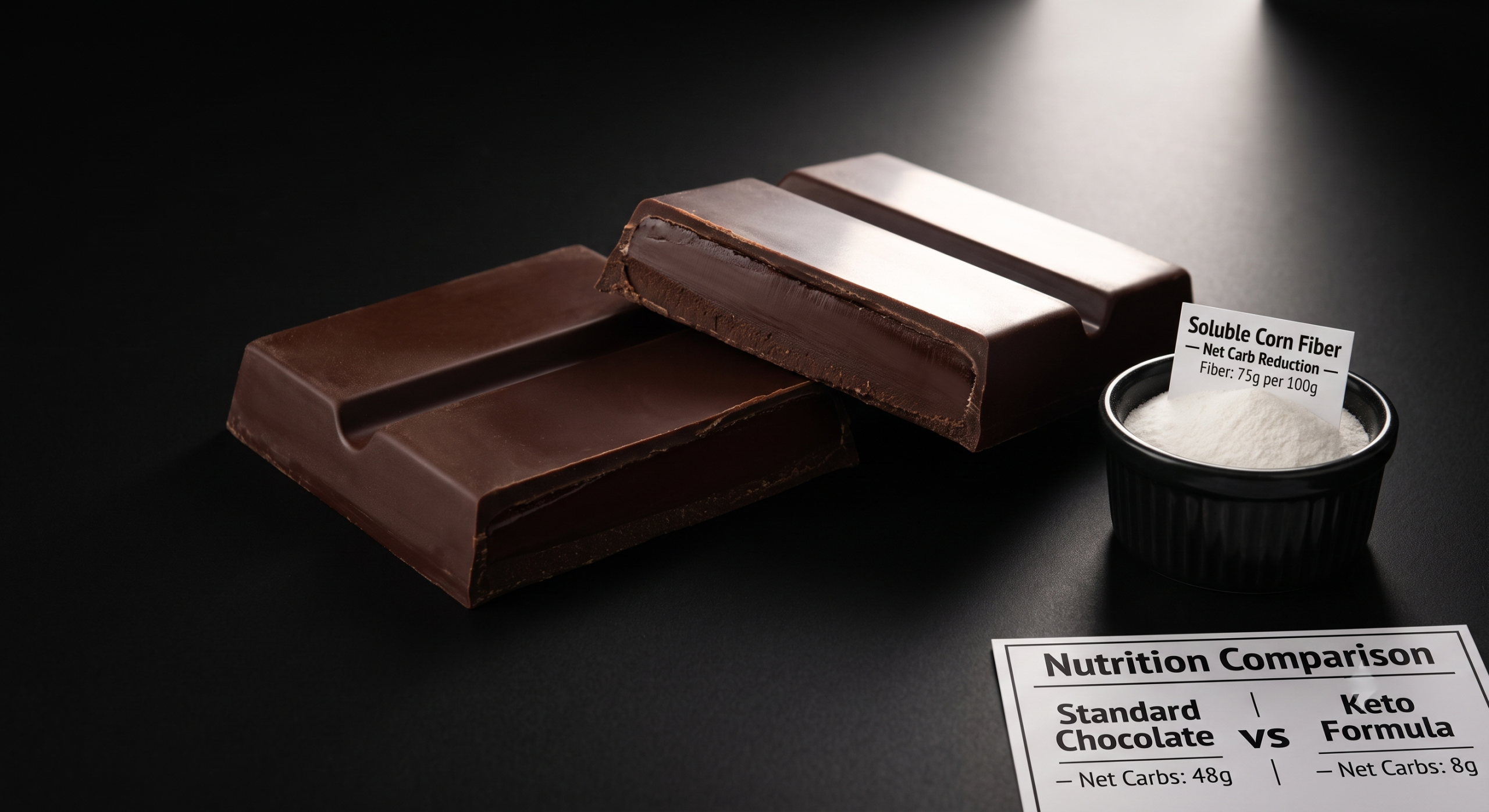
The defining physical attributes of premium chocolate a clean audible snap at ambient temperature and a high-gloss finish depend on maintaining cocoa butter in its stable Form V crystalline structure.
When formulating keto chocolate, blending spray-dried soluble corn fiber powder with cocoa mass and cocoa butter under controlled dry conching temperatures (55°C to 60°C) establishes an optimal viscosity and moisture matrix. Passing this mixture through a standard three-stage tempering loop induces stable Form V crystallization. This precise process results in a high-performing keto chocolate asset featuring a high-gloss surface finish with zero fat bloom, a clean hard snap at ambient temperatures, a smooth melt-down at body temperature (37°C), and a substantial net carb reduction to support on-pack keto claims.
Soluble corn fiber supports temper stability through three key physical mechanisms:
Low Moisture Activity: Premium spray-dried soluble corn fiber powder contains less than 5% native moisture. This prevents moisture-induced sugar bloom or thickening during the liquid phase.
Compatible Particle Size (Granulometry): Milled to a fine mesh matching cocoa solids (< 20 microns), soluble corn fiber distributes evenly throughout the cocoa butter continuous phase without causing grittiness.
Low Hygroscopicity: Unlike inulin or soluble tapioca fiber, which can attract atmospheric moisture during molding or enrobing, soluble corn fiber maintains low moisture absorption, preventing surface dullness over a 12-to-18-month shelf life.
Combining high-purity soluble corn fiber with natural high-intensity sweeteners (such as stevia or monk fruit) enables brand managers to build high-impact front-of-pack claims that drive category revenue. Expanding your low-carb and high-fiber portfolio directly increases top-line sales, as detailed in our analysis on the Revenue Case for Soluble Dietary Fiber Product Lines.
| Formulating Target | Sucrose-Based Standard Chocolate | Soluble Corn Fiber Keto Chocolate |
| Total Carbohydrates (per 30g) | ~18g | ~15g |
| Dietary Fiber (per 30g) | ~1g to 2g | ~10g to 12g (High Fiber Claim) |
| Net Carbohydrates (per 30g) | ~16g to 17g | ~2g to 3g (Keto-Friendly Claim) |
| Glycemic Impact | High | Low / Blunted Blood Glucose Response |
To ensure your front-of-pack fiber and low-carb messaging complies with international standards, consult our Legal High Fiber Claim Guide for EU & US Markets. Furthermore, because soluble corn fiber ferments gradually in the lower GI tract, it serves as a gentle option for brands executing Low-FODMAP product strategies.
To maximize efficiency when scaling soluble corn fiber keto chocolate on commercial lines:
Pre-Dry Bulking Agents: Ensure the spray-dried soluble corn fiber powder is stored in sealed bags at < 20°C and < 50% RH prior to batching to keep moisture below 4%.
Conching Temperature Controls: Keep conching temperatures for dark keto chocolate between 55°C and 60°C (and < 50°C for milk-style bases) to prevent moisture trapping or heat-induced aggregation.
Emulsifier Balancing: Adjust lecithin or polyglycerol polyricinoleate (PGPR) usage by 0.1% to 0.3% to lower yield stress and ensure smooth flow into molds or over enrobed centers.
Scaling a premium keto chocolate line requires a functional fiber supplier that delivers low moisture volatility, fine particle size distribution, and guaranteed batch-to-batch fiber purity. Blue Highcrest provides high-grade soluble corn fiber engineered specifically for delicate confectionery and baking applications.
Our functional fiber solutions offer:
Guaranteed Minimum 85% Dietary Fiber: High purity to achieve low net-carb calculations without swelling serving sizes.
Ultra-Low Moisture Content: Meticulously spray-dried to prevent viscosity spikes and fat bloom in chocolate matrices.
Neutral Flavor and High Clarity: Completely free from off-notes or sour tones, allowing rich cocoa flavor notes to shine.
Full Regulatory Compliance: Fully non-GMO, allergen-free, and backed by comprehensive Certificates of Analysis (COA).
Don’t let texture defects or high net carbs limit your product’s potential in the fast-growing functional confectionery market. Partner with Blue Highcrest to access high-purity soluble corn fiber backed by technical expertise and reliable global supply lines.
Ready to validate our soluble corn fiber in your chocolate trials? Visit Blue Highcrest to request a commercial sample kit, complete product specifications, and direct formulation support from our application team.
High-purity soluble corn fiber powder with a low moisture baseline (< 4%) behaves similarly to sucrose during tempering. It maintains stable Casson viscosity and yield stress, allowing liquid chocolate to flow smoothly into molds without clogging deposition nozzles.
Net carbs are calculated by subtracting total dietary fiber and approved non-glycemic sugar alcohols from total carbohydrates (Total Carbs – Dietary Fiber – Polyols = Net Carbs). Because soluble corn fiber passes through the small intestine unabsorbed, its mass is fully deductible.
No. Soluble corn fiber has low hygroscopicity and does not dissolve or migrate to the surface like sucrose or polyols when exposed to minor humidity changes, effectively preventing sugar bloom.
Yes. Blending soluble corn fiber with small amounts of erythritol or allulose provides the ideal balance of physical bulk, natural sweetness, and low net carbs while masking the cold mouthfeel associated with pure polyols.