
Top-performing private label healthy snacks succeed because they combine industrial formulation stability such as controlled water activity, zero structural breakage, and clean-label dough rheology with strategic front-of-pack (FOP) claim stacking. Private label snacks that stall on retail shelves usually fail due to unrefined prototype formulas, weak ingredient storytelling, or uncalibrated texture profiles that break down over global transit.
In the fast-moving consumer goods (FMCG) sector, launching a private label snack line offers massive margin potential. Retail buyers and brand directors are rushing to capitalize on consumer demand for gluten-free, plant-based, and functional crunch options. However, entering the retail space requires more than putting an attractive logo on a generic recipe.
Understanding the operational differences between a commercial asset and an unrefined kitchen concept is the first step toward building a long-term retail presence. To de-risk your initial production run, review our guide on Private Label Healthy Snacks: Prototype vs. Launch-Ready Assets.
A private label snack must be engineered to withstand automated manufacturing, extended warehousing, and global distribution without compromising its sensory profile.
The Benchmark: Maintain water activity strictly below 0.60 water activity.
The Impact: Controlling unbound moisture prevents microbial growth, stops lipid rancidity, and eliminates the dreaded “stale crunch” without relying on artificial chemical preservatives.
The Benchmark: Calibrate dough elasticity using clean-label starches like whole-root cassava flour to ensure a high force-to-fracture ratio.
The Impact: Snacks that shatter into dust inside nitrogen-flushed pouches lead to high retail return rates and poor online customer reviews.
The Benchmark: Eliminate synthetic binders, palm oil, and artificial flavor maskers.
The Impact: Modern shoppers scrutinize back-of-pack ingredient decks. Utilizing recognizable, non-GMO whole foods aligns directly with Clean-Label Ingredient Trends in US and EU Food Retail.
The Benchmark: Validate heat-seal integrity against high-oil or high-fiber ingredient migration.
The Impact: Preserves nitrogen gas flushes, locking in crispness and preventing flavor degradation over a 12-to-18-month retail shelf life.
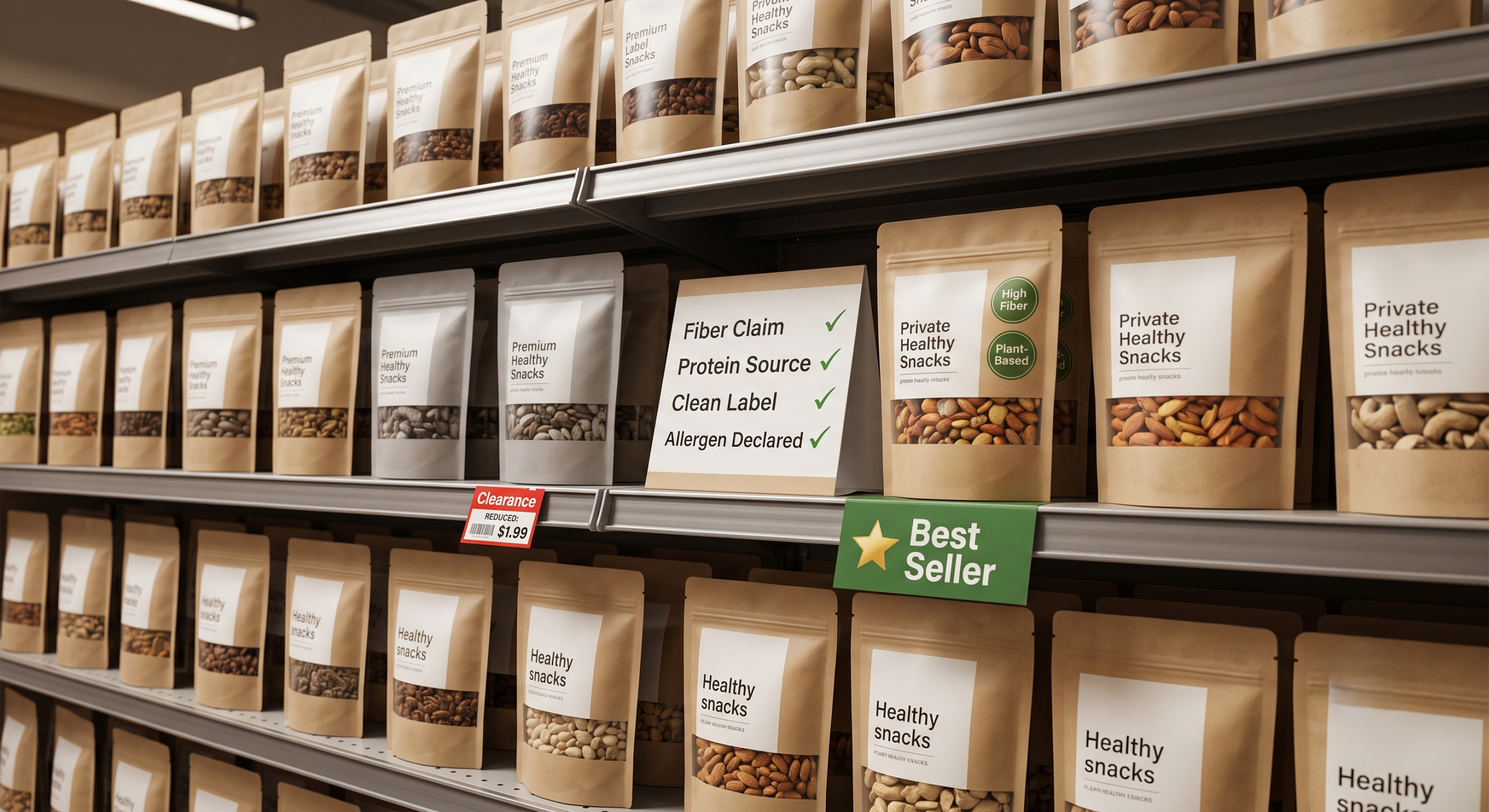
Once the underlying food science is locked in, market velocity depends on strategic brand positioning. Snacks that sit on shelves often treat packaging as an ingredient declaration rather than a marketing vehicle.
| Positioning Strategy | Commodity Snack (Low Velocity / High Churn) | Premium Private Label Asset (High Velocity / High Retention) |
| Front-of-Pack (FOP) Message | Single claim (e.g., “Gluten-Free”) | Dual-claim stacking (e.g., “5g Fiber + 10g Plant Protein”) |
| Ingredient Storytelling | Generic starches & cheap fillers | Hero ingredient focus (e.g., “Sustainably Sourced Cassava Root”) |
| Sensory Callout | Basic flavor naming (e.g., “Salted”) | Experiential texturing (e.g., “Slow-Baked Artisanal Root Crunch”) |
| Retail Positioning | Price-driven value aisle placement | Health & Wellness / Premium Functional Snack aisle |
Effective ingredient storytelling allows private label owners to command higher price points on Amazon and retail shelves, boosting profit margins per SKU. Learn how to craft high-converting product narratives in our guide on Ingredient Storytelling to Increase Retail and Amazon Value.
Combining high-fiber carbohydrate bases with plant-based proteins is the fastest way to elevate a private label product line into the functional food tier.
[ Cassava Flour Base ] + [ Soluble Tapioca Fiber ] + [ Pea Protein Isolate ]
                               │
                               ▼
┌────────────────────────────────────────────────────────┐
│            Dual-Claim Front-of-Pack Callout            │
│       "High Fiber (Prebiotic) + Plant Protein"         │
└────────────────────────────────────────────────────────┘
                               │
                               ▼
┌────────────────────────────────────────────────────────┐
│               Commercial Brand Impact                  │
│  • Premium Shelf Placement (Higher Retail Margin)     │
│  • Enhanced Consumer Satiety & Satiety Retention       │
│  • Distinct Competitive Advantage Over Single-Claims  │
└────────────────────────────────────────────────────────┘
By stacking claims—such as pairing prebiotic fiber with plant protein—brands tap into high-growth consumer categories like gut health, metabolic wellness, and low-glycemic snacking. Unlocking these dual-claim callouts expands your addressable market and builds long-term customer loyalty, as detailed in our analysis of the Revenue Case for Soluble Dietary Fiber Product Lines.
Turning a private label concept into a market-leading retail asset requires a supply partner with deep technical expertise, turnkey private label services, and reliable raw material supply chains. Blue Highcrest specializes in formulating and manufacturing high-performance, launch-ready private label healthy snacks.
Our private label solutions deliver:
Fully Turnkey Formulations: Pre-tested, shelf-stable gourmet root crackers, plant-based chips, and functional snacks engineered for high-volume automated lines.
Standardized Clean-Label Ingredients: Sourced directly from our certified cassava flour and tapioca fiber supply chains to guarantee batch-to-batch consistency.
Global Regulatory Compliance: Fully documented specifications, non-GMO verifications, and GFSI-recognized quality certifications for seamless entry into US and EU retail channels.
To successfully phase out costly in-house blending across your hotel portfolio or fleet:
Consolidate Your Flour Registry: Direct global purchasing desks to replace separate alternative flour SKUs with a single, functional premix baseline.
Standardize Hydration Standard Operating Procedures (SOPs): Issue unified water-to-premix calculation sheets to line cooks to lock in exact batch yields.
Execute Certified Pre-Packaged Training: Train preparation teams to utilize sealed bags directly, completely eliminating airborne dust vectors in the pastry galley.
Don’t risk your brand’s reputation and capital on unverified kitchen prototypes that struggle under commercial retail conditions. Partner with Blue Highcrest to develop, scale, and launch premium private label healthy snacks designed for high sell-through rates.
Ready to evaluate our launch-ready snack capabilities? Contact our commercial brand team at Blue Highcrest to request custom sample kits, product specification guides, and private label co-manufacturing terms.
Staling is primarily caused by poor water activity ($a_w$) control or inadequate moisture-barrier packaging. If $a_w$ exceeds 0.60, ambient humidity migrates into the starch matrix, softening the texture and accelerating flavor degradation over time.
While premium clean-label ingredients like cassava flour and soluble tapioca fiber may have a higher raw material cost per kilogram than commodity corn or wheat, they allow brand owners to position products in premium retail tiers, yielding significantly higher retail gross margins and stronger customer lifetime value.
Major US and EU retailers require products to be manufactured in GFSI-certified facilities (such as BRCGS or FSSC 22000), supported by Non-GMO, Gluten-Free, and relevant allergen-free validation testing.
Yes. Blue Highcrest’s technical R&D team works directly with brand owners to tailor formulations for specific market targets, including High Fiber, Plant Protein, Low-FODMAP, Vegan, and Grain-Free positioning.