
Combining whole-root cassava flour with highly concentrated soluble tapioca fiber allows food technologists to “stack” dietary fiber metrics to easily surpass FDA and EU “High Fiber” claim thresholds. This dual-tapioca strategy delivers a clean-label, allergen-free carbohydrate matrix that bolsters fiber content without causing the dough stiffness or grittiness associated with traditional fiber sources.
For R&D teams and food scientists, engineering a high-fiber baked good or extruded snack often feels like a compromise between regulatory compliance and sensory appeal. Adding high levels of insoluble fiber usually turns doughs chalky, while commodity soluble fibers like inulin can cause digestive discomfort or undesirable browning due to Maillard reactions during thermal processing.
By leveraging a single-origin, dual-ingredient strategy—combining the native dietary fiber and structural starch of whole cassava flour with the high-purity bulk of soluble tapioca fiber—formulators can hit aggressive front-of-pack fiber claims while optimizing moisture retention and dough rheology.
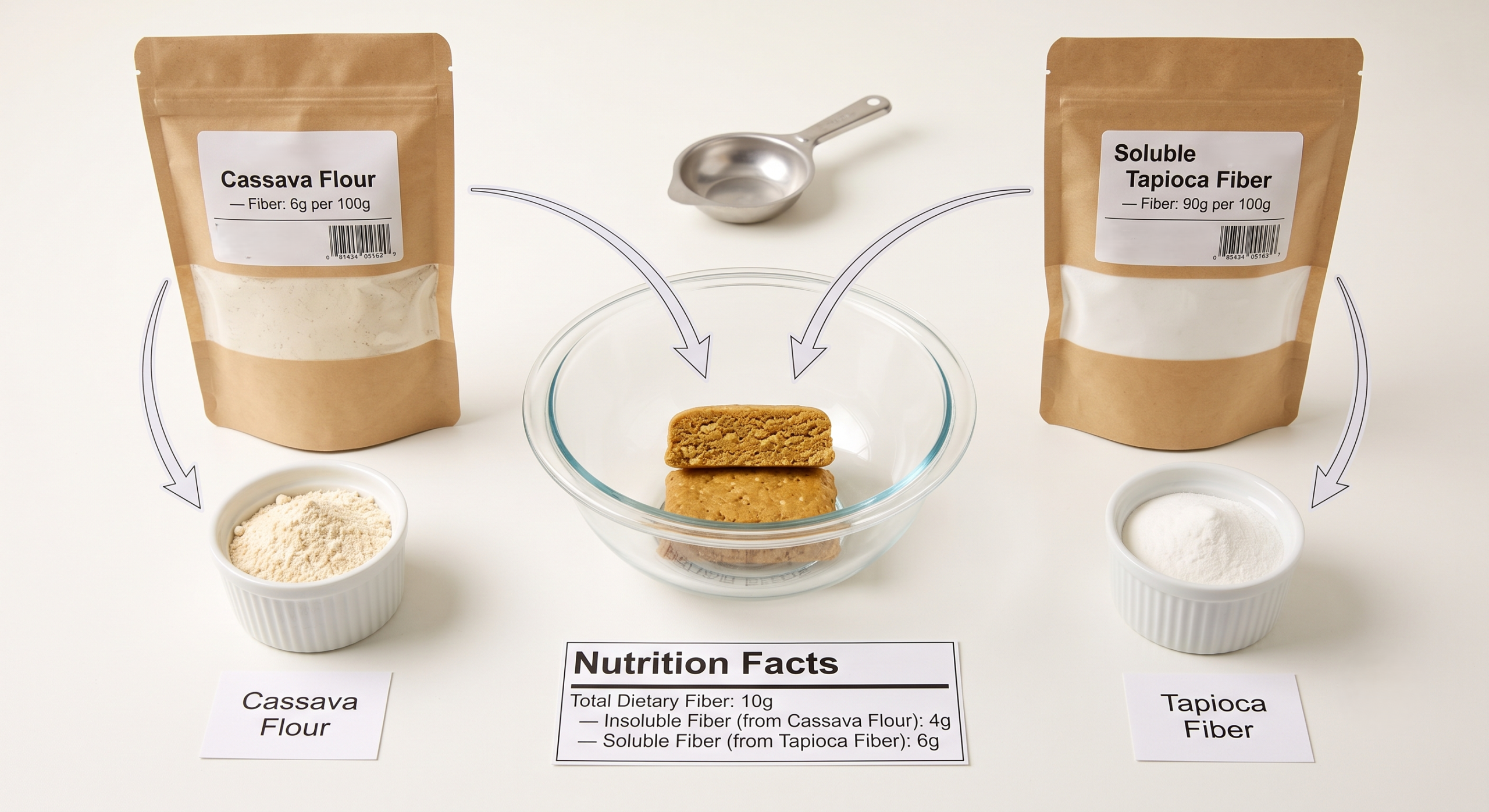
To understand why this dual-ingredient system works so well on the bench, formulators must look at how the two fiber types interact within a hydrated dough matrix:
Cassava flour is made from the entire cassava root, retaining native insoluble and soluble dietary fiber (typically 4% to 6% by weight). Beyond its fiber contribution, cassava flour provides clean gelatinization, excellent dough binding, and a smooth mouthfeel. However, relying on cassava flour alone to hit a “High Fiber” claim would require massive inclusion rates, making the final dough overly dense.
Derived from tapioca starch through targeted enzymatic hydrolysis, soluble tapioca fiber offers a fiber concentration of 70% to 90% on a dry basis. It acts as a liquid syrup or clear powder binder that contributes negligible viscosity, low sweetness, and exceptional solubility.
When combined, cassava flour provides the structural bulk and starch matrix, while soluble tapioca fiber carries the heavy nutritional load. This balance prevents the dough from drying out, buffers against retrogradation (staling), and maintains a tender crumb structure in baked goods or a crisp, light bite in extruded snacks.
To legally stack fiber claims, your target inclusion rates must meet regional regulatory benchmarks per serving size (RACC) without inflating overall caloric load.
| Regulatory Region | Claim Standard | Minimum Fiber Requirement | Strategic Formula Solution |
| United States (FDA 21 CFR 101) | “Good Source of Fiber” | 2.8g to 5.3g per RACC (10–19% DV) | 15% Cassava Flour + 3% Soluble Tapioca Fiber |
| United States (FDA 21 CFR 101) | “High Fiber / Excellent Source” | > 5.6g per RACC (>20% DV) | 20% Cassava Flour + 6% Soluble Tapioca Fiber |
| European Union (EC 1924/2006) | “Source of Fibre” | 3g per 100g OR 1.5g per 100 kcal | 15% Cassava Flour + 2% Soluble Tapioca Fiber |
| European Union (EC 1924/2006) | “High Fibre” | > 6g per 100g OR 3g per 100 kcal | 20% Cassava Flour + 5% Soluble Tapioca Fiber |
For a complete breakdown of international legal compliance and ingredient registry requirements, review our comprehensive Legal High Fiber Claim Guide for EU & US Markets.
Swapping synthetic or grain-based fibers for a cassava-soluble tapioca fiber system solves the most common bench-top and scaling bottlenecks faced by food technologists:
Digestive Tolerance: Unlike chicory root/inulin, which rapidly ferments in the gut and causes gas and bloating, soluble tapioca fiber has high digestive tolerance, allowing for elevated inclusion rates.
Moisture Management and Shelf Life: Soluble tapioca fiber acts as a natural humectant. In high-protein or high-fiber systems, it binds free water and maintains low water activity ($a_w$), preventing bars from hardening and cookies from turning crumbly over time.
Color Control and Maillard Reaction: Compared to soluble corn fiber alternatives, soluble tapioca fiber features low reducing sugar levels, preventing excessive browning or burning during high-temperature baking and extrusion.
When formulating a high-fiber bakery item, snack, or bar using this stacked ingredient approach, follow this benchtop protocol to ensure seamless dough rheology:
Dry Blend Pre-Hydration: Combine the cassava flour with your dry inclusions and dry soluble tapioca fiber (if using powder) in a ribbon or planetary mixer for 2 minutes to achieve uniform distribution.
Liquid Phase Calibration: If using liquid soluble tapioca fiber syrup, blend it directly with your formula liquids (water, oils, liquid sweeteners) at 30°C to 35°C before introducing the dry phase. This lowers syrup viscosity and ensures even coating.
Water Activity Audit: Test the final hydrated matrix post-mixing. Aim for a water activity range between 0.45 and 0.60 for shelf-stable snacks to inhibit microbial growth while preserving chewiness or crispness.
Achieving clean-label, high-fiber compliance requires raw materials backed by technical precision and strict batch-to-batch consistency. Blue Highcrest provides commercial-grade cassava flour and high-purity soluble tapioca fiber engineered to streamline dual-fiber formulations for food developers and wholesale manufacturers.
Our ingredient solutions offer:
Single-Origin Supply Synergy: Simplify your ingredient deck and supply chain traceability by sourcing both your flour and functional fiber from a single trusted partner.
Neutral Flavor & Color Profiles: Eliminate off-notes, earthy aromas, or unwanted dark colors in delicate, light-colored baked goods and bars.
Complete Technical Documentation: Every shipment is supported by full Certificates of Analysis (COA), non-GMO declarations, and validated dietary fiber assay data.
Don’t let formulation trade-offs delay your next major retail launch. Partner with Blue Highcrest to access premium cassava ingredients engineered to satisfy the rigorous technical, legal, and sensory demands of global markets.
Ready to validate this dual-fiber strategy in your pilot facility? Contact our application specialists at Blue Highcrest to request a custom sample kit, complete product specifications, and direct technical formulation guidance.
Yes. High-purity soluble tapioca fiber is recognized as a legitimate, health-promoting isolated dietary fiber under FDA guidelines, providing validated physiological benefits like improved glycemic response and digestive health.
Soluble tapioca fiber acts as an exceptional binder and humectant, preventing the “protein hardening” phenomenon over shelf life. Paired with cassava flour, it creates a smooth, cohesive matrix that keeps bars soft and pliable without feeling sticky.
Yes. Because both ingredients are derived from the cassava root (Manihot esculenta), your ingredient declaration remains extremely clean and consumer-friendly (e.g., “Cassava Flour, Soluble Tapioca Fiber”).
No. Soluble tapioca fiber features high thermal and acid stability. It withstands the intense shear, pressure, and heat of high-temperature short-time (HTST) extrusion without breaking down into simple sugars or losing its dietary fiber value.