
Building a profitable private label vegan cracker SKU requires balancing clean-label ingredient choices such as whole-root cassava flour and plant proteins with automated production efficiencies, controlled water activity, and strategic front-of-pack (FOP) claim stacking. Brand owners can secure high retail gross margins while eliminating the risk of product breakage and early staling by streamlining the process from initial supplier brief to final shelf placement.
For private label buyers and brand directors, the plant-based snack category represents one of the fastest-growing segments in food retail. Consumers are actively seeking clean-label, gluten-free, and top-9 allergen-free alternatives to commodity wheat crackers. However, bringing a new vegan cracker SKU to market involves navigating tight retail price ceilings, high slotting fees, and complex co-manufacturing economics.
Understanding how to structure a margin-positive formulation from day one ensures your brand delivers high consumer value without eroding bottom-line profitability.
A private label vegan cracker SKU becomes margin-positive when its formulation is engineered for industrial scaling, achieving a high product yield per batch while maintaining a retail gross margin above 40% to 50%. This is accomplished by replacing expensive synthetic binders with functional clean-label starches (like cassava flour), keeping water activity below 0.55 to guarantee a 12-to-18-month shelf life without chemical preservatives, and stacking high-value claims (such as “Grain-Free + Plant Protein”) to command premium retail pricing.
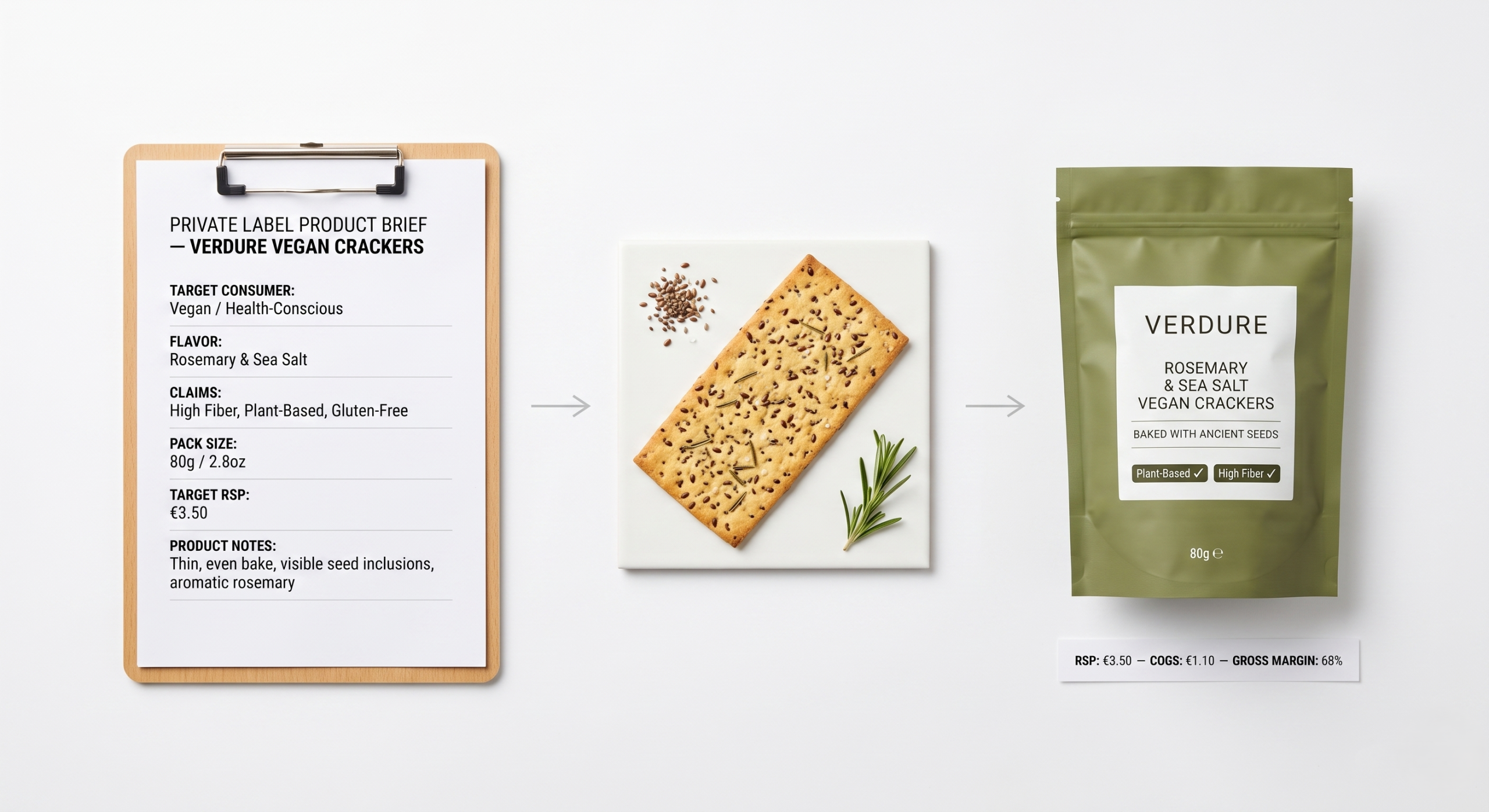
The foundation of a profitable private label SKU begins long before the first pilot run. As outlined in our strategic guide on how to write a food ingredient supplier brief, defining exact physical, functional, and commercial parameters prevents costly reformulation cycles later.
Base Flour Architecture: Specify whole-root cassava flour to establish an allergen-free, grain-free structure with strong natural binding and smooth sheetability.
Protein & Fiber Fortification: Define target inclusion rates for pea protein isolate and soluble tapioca fiber to achieve dual-claim status (“High Fiber” + “Plant Protein”) without introducing a chalky texture or leguminous off-notes.
Oil & Lipid Selection: Opt for non-GMO, heat-stable plant oils (such as high-oleic sunflower oil) that resist lipid oxidation, protecting flavor stability across the entire retail lifecycle.
Moving a vegan cracker recipe from bench-top prototype to continuous automated production lines is where many private label concepts suffer margin erosion. Without the natural elasticity of gluten, plant-based doughs can become sticky, brittle, or prone to tearing during high-speed sheeting.
An optimized clean-label dough matrix is critical for seamless automated processing. During high-speed sheeting and rotary cutting operations, a properly balanced matrix ensures uniform dough thickness with zero edge scrap. Following the cutting phase, applying a precise band-oven baking profile locks in the target water activity control ( water activity < 0.55). This exact manufacturing sequence yields a launch-ready private label cracker characterized by a high force-to-fracture ratio (eliminating transit breakage), a clean snap with crisp dip-retention texture, a guaranteed 12 to 18-month ambient shelf life, and maximized industrial yield for an optimized cost-per-kilo.
By balancing cassava flour’s starch gelatinization properties with functional plant proteins, R&D teams establish a dough matrix that sheets smoothly without jamming equipment. This high sheetability minimizes edge scrap, maximizes throughput, and lowers the finished cost-per-kilo. For a deeper breakdown of operational readiness, review our checklist on Private Label Healthy Snacks: Prototype vs. Launch-Ready Assets.
Achieving a healthy margin structure requires evaluating every component of the finished unit cost before committing to commercial co-manufacturing contracts.
| Cost Component | Commodity Wheat Cracker (Low Margin / High Churn) | Premium Private Label Vegan Cracker (High Margin / High Retention) |
| Raw Material Deck | Commodity wheat flour + synthetic additives | Clean-label cassava flour + pea protein + functional fiber |
| Production Scrap Rate | 8% – 12% (High breakage in transit) | < 3% (Calibrated force-to-fracture matrix) |
| Packaging Barrier | Standard clear film pouch | High-barrier nitrogen-purged foil pouch |
| Target Retail Margin | 20% – 30% | 45% – 55%+ |
| Consumer Positioning | Price-driven commodity aisle | Premium Health & Wellness / Specialty Plant-Based |
By positioning the cracker in the premium functional tier, brand owners absorb higher raw material costs while securing substantially larger absolute dollar margins per unit sold.
A technically perfect vegan cracker will still sit on retail shelves if its packaging fails to communicate value immediately to the consumer. Modern shoppers make purchasing decisions in seconds based on front-of-pack claims and back-of-pack ingredient transparency.
To maximize velocity on Amazon and traditional supermarket shelves:
Stack High-Value Claims: Combine messaging like “Grain-Free,” “Plant-Based Protein,” and “Prebiotic Fiber” on the front panel to appeal to multiple diet trends (Keto, Paleo, Low-FODMAP, Vegan).
Leverage Ingredient Storytelling: Highlight sustainably sourced whole-root cassava and allergen-free pea protein rather than generic starch titles. For actionable branding strategies, explore our guide on Ingredient Storytelling to Increase Retail and Amazon Value.
Emphasize Structural Experience: Promote sensory descriptors like “Artisanal Crunch,” “Crisp Dip-Retention,” and “Slow-Baked Clean Snap.”
Transitioning a private label concept into a high-selling retail asset requires a co-manufacturing and ingredient supply partner who understands both food science and commercial economics. Blue Highcrest specializes in developing and supplying turnkey, launch-ready private label vegan crackers and gourmet root chips engineered for high-volume retail success.
Our turnkey private label solutions deliver:
Launch-Ready Formulations: Pre-tested, shelf-stable vegan cracker bases that scale seamlessly on automated production lines without structural defects.
Vertical Ingredient Integration: Formulated using our own premium cassava flour, tapioca starches, and functional plant proteins to guarantee direct-from-source pricing and batch-to-batch consistency.
Global Compliance & Safety: Manufactured under strict GFSI-recognized standards (BRCGS/FSSC 22000), fully backed by Non-GMO, Gluten-Free, and complete COA documentation for US and EU markets.
Don’t risk your capital or retail relationships on unproven kitchen prototypes that fail during mass production. Partner with Blue Highcrest to build, scale, and launch margin-positive private label vegan crackers designed for commercial growth.
Ready to evaluate our launch-ready vegan cracker capabilities? Contact our commercial brand team at Blue Highcrest to request custom sample kits, full specification sheets, and co-manufacturing partnership terms.
High-purity soluble corn fiber powder with a low moisture baseline (< 4%) behaves similarly to sucrose during tempering. It maintains stable Casson viscosity and yield stress, allowing liquid chocolate to flow smoothly into molds without clogging deposition nozzles.
Net carbs are calculated by subtracting total dietary fiber and approved non-glycemic sugar alcohols from total carbohydrates (Total Carbs – Dietary Fiber – Polyols = Net Carbs). Because soluble corn fiber passes through the small intestine unabsorbed, its mass is fully deductible.
No. Soluble corn fiber has low hygroscopicity and does not dissolve or migrate to the surface like sucrose or polyols when exposed to minor humidity changes, effectively preventing sugar bloom.
Yes. Blending soluble corn fiber with small amounts of erythritol or allulose provides the ideal balance of physical bulk, natural sweetness, and low net carbs while masking the cold mouthfeel associated with pure polyols.