
Commercial cassava flour often carries distinct sour, earthy, or fermented off-odors caused by poor post-harvest handling and volatile organic compounds (VOCs) like butyric acid. Upgrading to a certified neutral-odor grade ensures a clean sensory profile, completely eliminating the need for expensive flavor maskers while stabilizing your dough matrix for scaling.
For food technologists and brand managers, developing a clean-label, grain-free product is a balancing act between physical performance and sensory appeal. Cassava flour has rapidly become the preferred choice for industrial allergen-free wheat flour substitution, thanks to its excellent binding and structure. However, many R&D teams encounter a major roadblock during initial bench trials: a persistent, pungent aroma that bleeds into the final product.
Understanding the biochemical origin of this odor—and how a technical-grade, neutral-odor specification corrects it—is essential to transforming a challenging prototype into a market-ready retail asset.
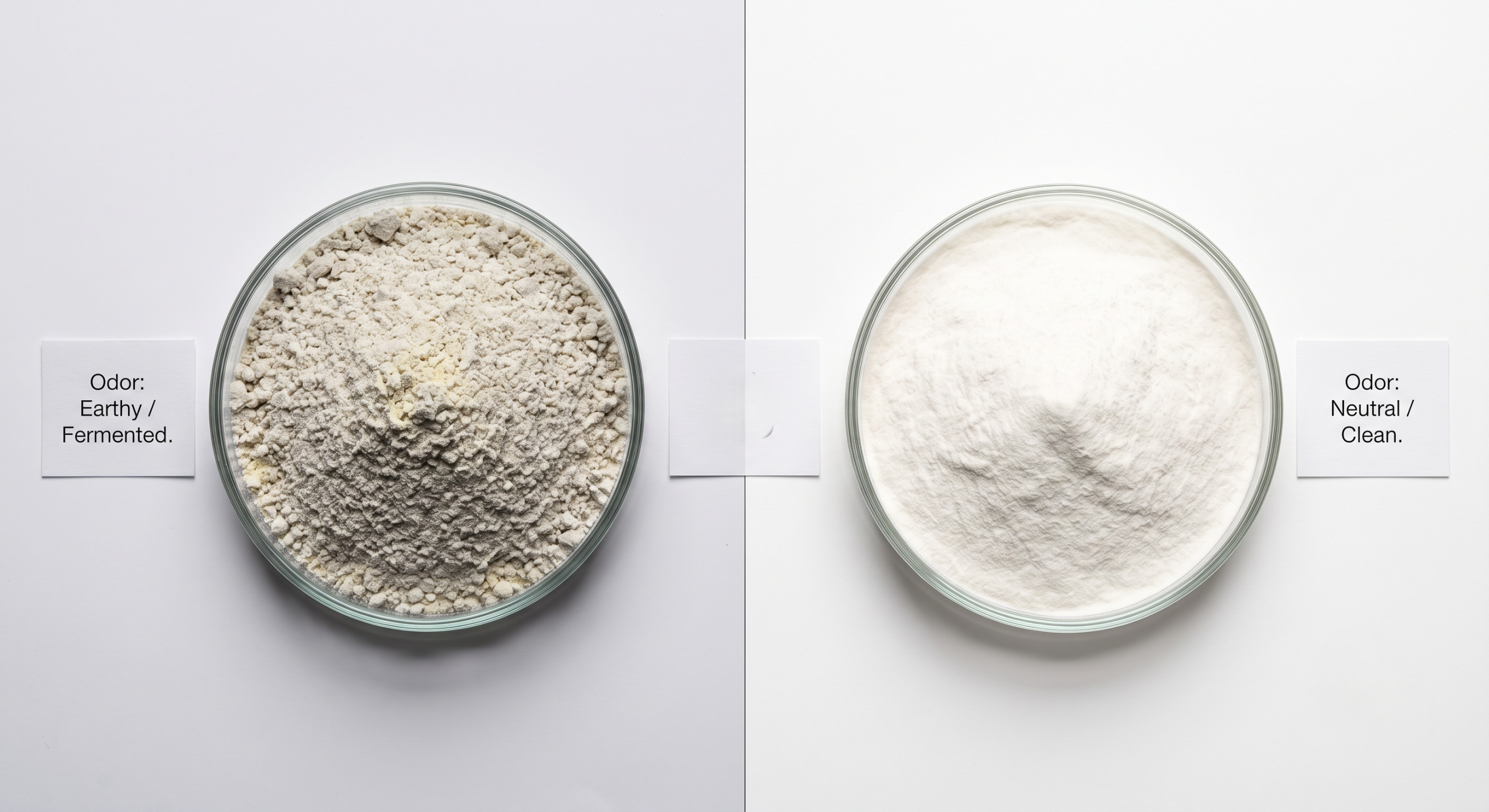
The characteristic smell found in standard commodity cassava flour is not an inherent trait of the plant; it is a direct byproduct of processing delays at the agricultural source.
Post-Harvest Physiological Deterioration (PPD): Cassava roots are highly perishable. Once harvested, enzymatic browning and metabolic breakdown begin within 24 to 48 hours, releasing volatile fatty acids that create a distinct “sour” or “woody” profile.
Anaerobic Fermentation: When large bulk harvests sit in high-humidity ambient environments prior to peeling and washing, wild yeast and lactic acid bacteria proliferate. This leads to the generation of compounds like butyric, acetic, and propionic acids.
Thermal Oxidation during Drying: Inadequate temperature control during flash-drying or open-air sun drying can oxidize native lipids, anchoring a heavy, damp-earth smell directly into the starch granules.
When a formulation suffers from raw material odor volatility, it triggers a costly chain reaction across both technical and commercial departments.
From an R&D standpoint, technologists are forced to introduce artificial masking agents, botanical flavors, or heavy sweeteners to shield the consumer’s palate. This instantly ruins the “Clean Label” initiative, inflates the total cost-per-kilo of the dough matrix, and can shift the extrusion gelatinization expansion behaviors if the maskers alter the moisture-binding dynamics.
From a Brand Manager’s perspective, consumer retention drops sharply if a healthy snack releases a sour aroma upon opening the retail pouch. Modern health shoppers demand functional benefits without sacrificing clean sensory purity. A neutral base is non-negotiable for delicate applications like neutral crackers, sugar-free cookies, and functional beverage blends.
To protect your formulation parameters, your procurement and quality assurance teams must look beyond standard starch metrics and actively audit volatile and organic markers.
| Technical Specification | Standard Commodity Cassava Flour | Premium Neutral-Odor Grade (Blue Highcrest) |
| Volatile Organic Compounds (VOCs) | High levels of butyric & acetic acids | Trace / Below detectable limits |
| Native Moisture Baseline | Variable (12% – 14.5%) | Standardized (< 12% for stability) |
| Sensory Evaluation (Aroma/Taste) | Earthy, sour, strongly leguminous | Completely neutral; clean flour finish |
| Flavor Masking Required | High dosage (0.5% – 2.0% inclusion) | Zero masking required |
| Viscosity Reproducibility | Fluctuates due to uneven root aging | Strict batch-to-batch consistency |
By specifying a neutral grade, you ensure that the texturizing benefits of the whole root matrix function flawlessly without competing with your intended flavor profiles. For a comparative breakdown of how whole-root cassava flour interacts relative to isolated starches, see our Cassava Flour vs. Tapioca Starch Food Technologist Guide.
For private label buyers, speed-to-market depends on specifying ingredients that guarantee batch-to-batch consistency. A prototype built on unrefined whole-food starches often fails real-time accelerated shelf-life testing (ASLT).
To bridge this gap, brands must rely on refined, commercial-grade raw materials. Discover how to de-risk your commercial expansion in our guide on Private Label Healthy Snacks: Prototype vs. Launch-Ready.
Blue Highcrest provides standardized, commercial-grade ingredients that simplify dual-claim formulations:
Neutral Flavor Profiles: Our non-GMO pea protein isolate undergoes advanced wet filtration to remove earthy, “beany” off-notes, reducing the need for costly masking agents.
Uniform Granulometry: Standardized mesh sizes across both our cassava flour and pea protein ensure rapid, predictable hydration during high-speed mixing.
Complete Traceability: Full compliance documentation, non-GMO verifications, and COAs backing every shipment to streamline your retail audit process.
Overcoming raw material volatility requires a highly controlled, sophisticated supply chain. Blue Highcrest delivers premium, commercial-grade cassava flour engineered specifically to eliminate off-odors while protecting industrial performance.
Our manufacturing process ensures absolute neutrality through:
Immediate Post-Harvest Milling: Roots are processed within hours of harvest, completely stopping the enzymatic degradation and fermentation cycles before they start.
Multi-Stage Purified Washing: Advanced hydrocyclone washing systems strip away external surface organics and native latex compounds.
Low-Temperature Flash Dehydration: Precise thermal controls gently remove moisture down to uniform baselines, preventing starch damage and lipid oxidation.
Before committing a new cassava lot to large-scale production runs, implement this simple sensory and thermal stress protocol in your test kitchen:
The Slurry Test: Mix 50g of the test cassava flour with 100ml of distilled water at 70°C in a sealed glass jar.
The Evaluation: Let the sample sit for 3 minutes to initiate starch swelling, then open the lid. A standard commodity flour will immediately throw off heavy sour steam. A certified neutral grade will yield only a faint, sweet, milk-like cereal aroma.
Don’t let raw material off-notes compromise your product launch or complicate your ingredient deck. Blue Highcrest provides premium, clean-label, neutral-odor cassava flour designed to fulfill the rigid quality and sensory benchmarks of global food brands.
Ready to experience the difference a clean sensory base makes? Contact our technical sales team at Blue Highcrest to request a commercial sample kit alongside complete Certificates of Analysis (COA) and sensory grading reports.
No. The sour or fermented smell is caused by organic volatile acids from bacterial action and post-harvest delays, not hydrocyanic acid (cyanide). Blue Highcrest flour undergoes rigorous testing to guarantee full detoxification and safety well below international regulatory limits.
It improves predictability. Because neutral-odor cassava flour is harvested and milled uniformly, the starch structures remain intact. This delivers consistent peak viscosity and uniform cell expansion during extrusion, avoiding the collapse often caused by partially degraded, fermented batches.
Vacuum drying can flash off surface volatiles, but deeply embedded acids bound within the gelatinized starch matrix will release again when exposed to heat and moisture during final commercial baking or extrusion, meaning sourcing a clean grade from the start is essential.
Blue Highcrest’s strict moisture standard (<12%) prevents internal microbial activity and secondary staling inside your packaged goods, protecting both the chemical stability and aroma profile over a 12-to-18-month shelf life.